Blog

Highlights from the SETC Conference, Chattanooga

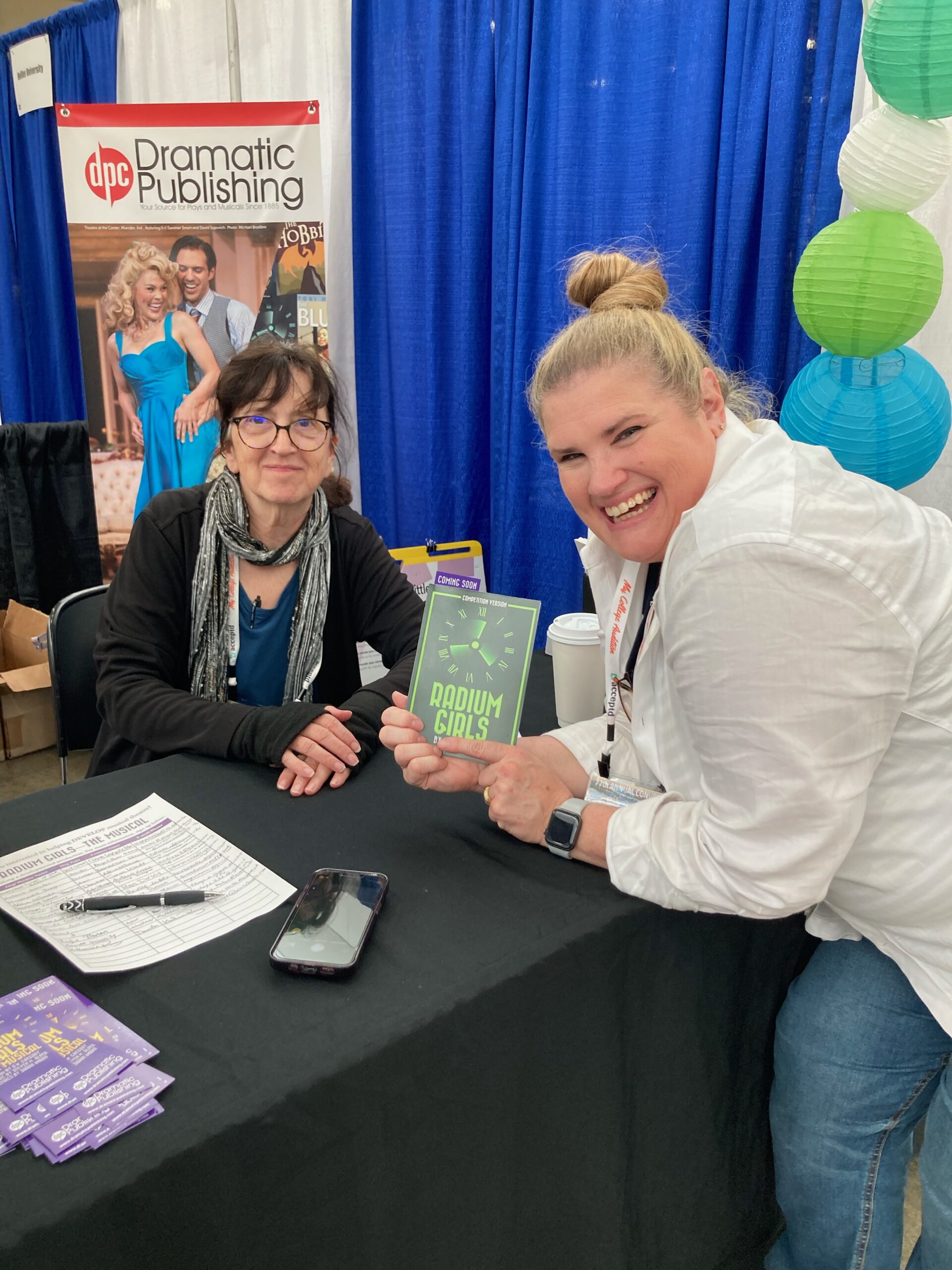
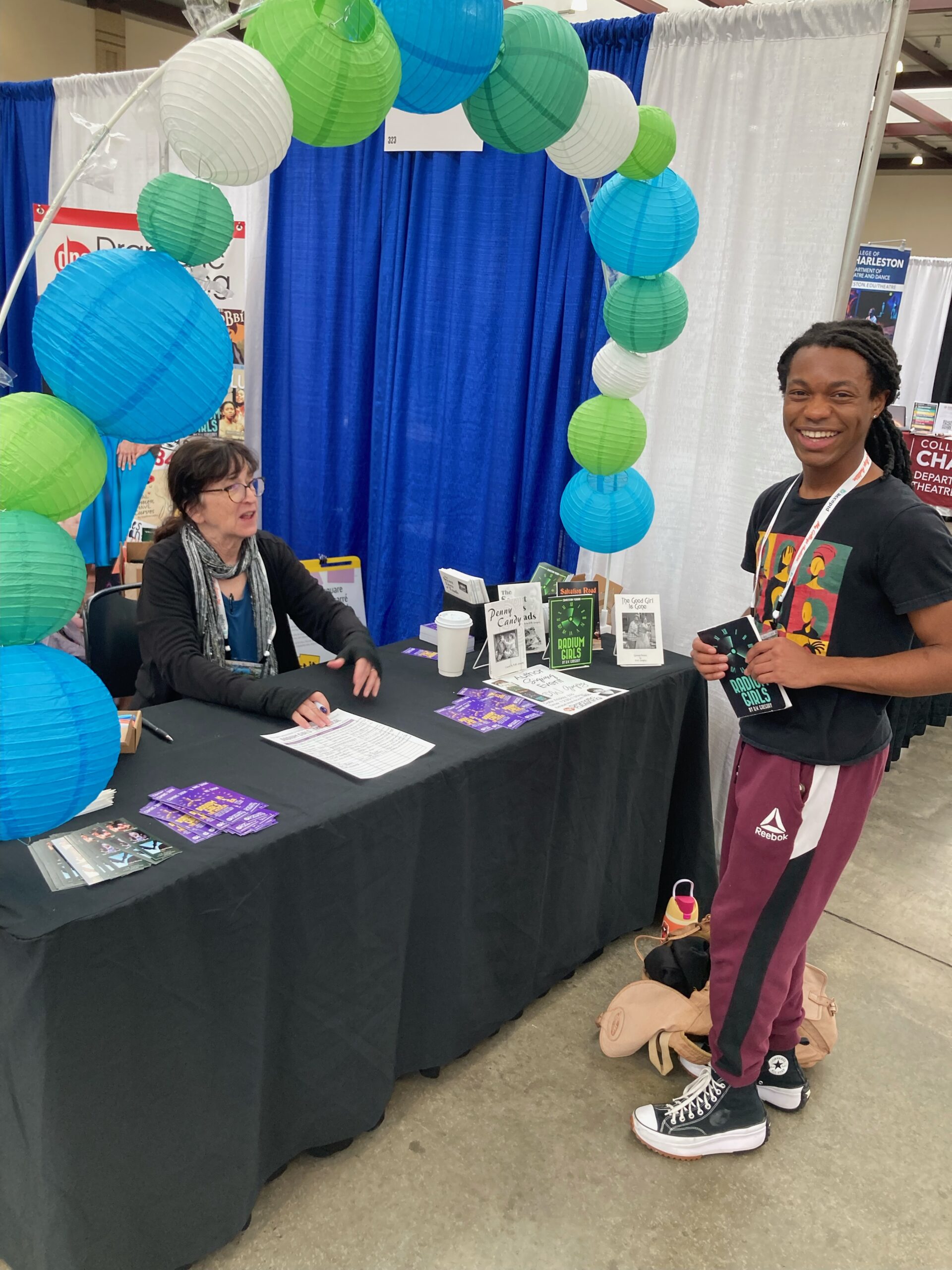
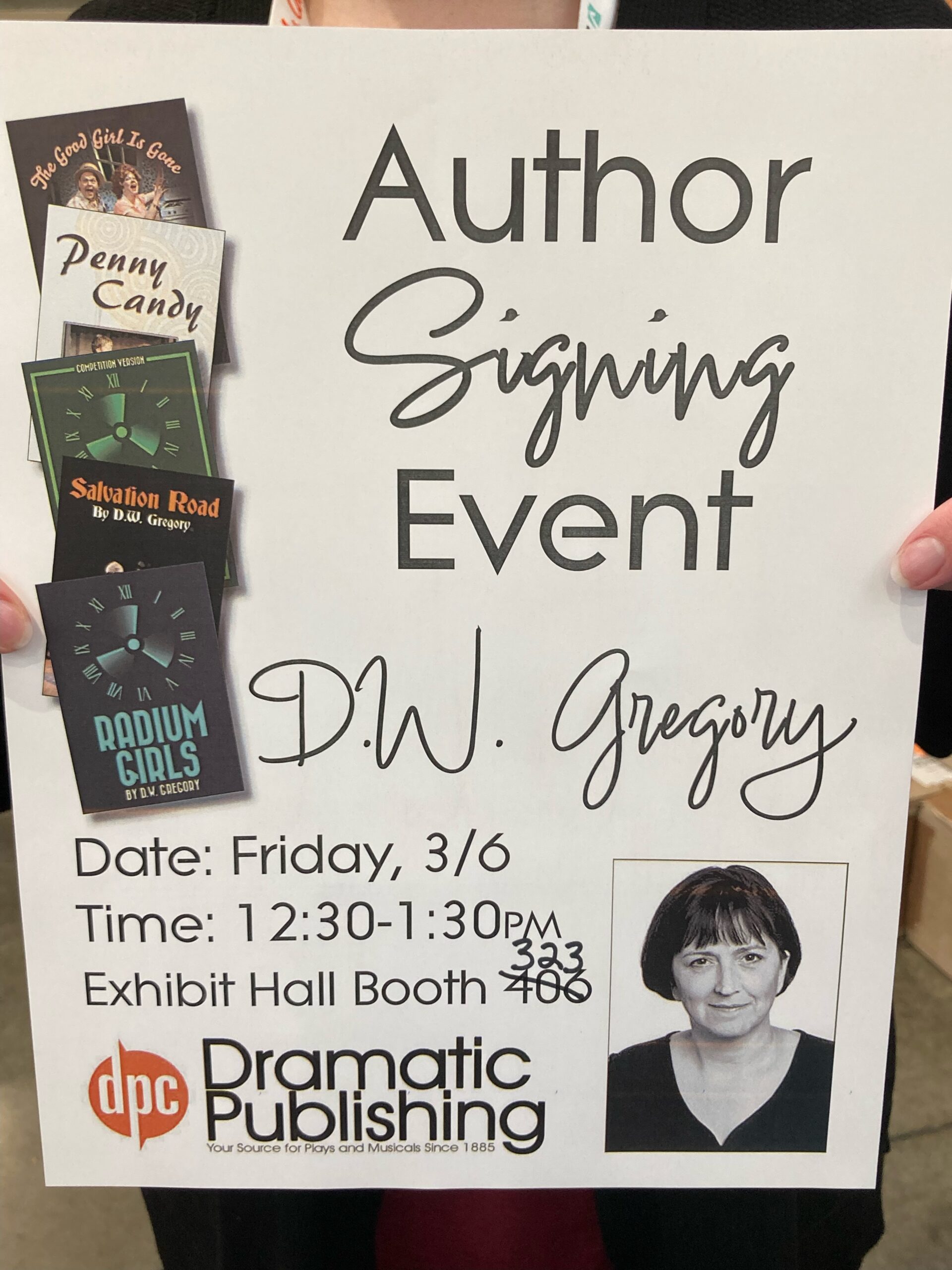
CHATTANOOGA, Tenn.– Dramatic Publishing hosted a book-signing for playwright D.W. Gregory, author of Radium Girls, at the Southeastern Theater Conference in Chattanooga, March 6.

“It’s always a blast coming to the SETC conference,” Gregory said. “This year was really special, with a book-signing at Dramatic’s Booth. I’m always amazed at the number of teachers and students who come up to me to share their excitement about the play. So many of them have either produced it or are planning to do it. It’s really something.”

One of the largest networks of professional, academic and amateur theatre practitioners in the country, SETC holds an conference annually in the 10-state southeastern region of the U.S. Its membership is  open to anyone in the U.S.

D.W. signs copies of her plays with Dramatic Publishing at the 2026 SETC conference.

Gregory was at the 2026 conference to teach a workshop on play structure, Turning Points in Drama. 

With more than 350 productions last year and nearly 3,000 productions since publication, Radium Girls was among the most produced plays in American theater in 2025, according to Playbill magazine. For seven years running, it was also among the top ten most produced plays in U.S. high schools.

Radium Girls one of several of Gregory’s scripts published by Dramatic. A one-act version is also a popular title with high schools and universities and is a frequent entry in thespian competitions around the country.

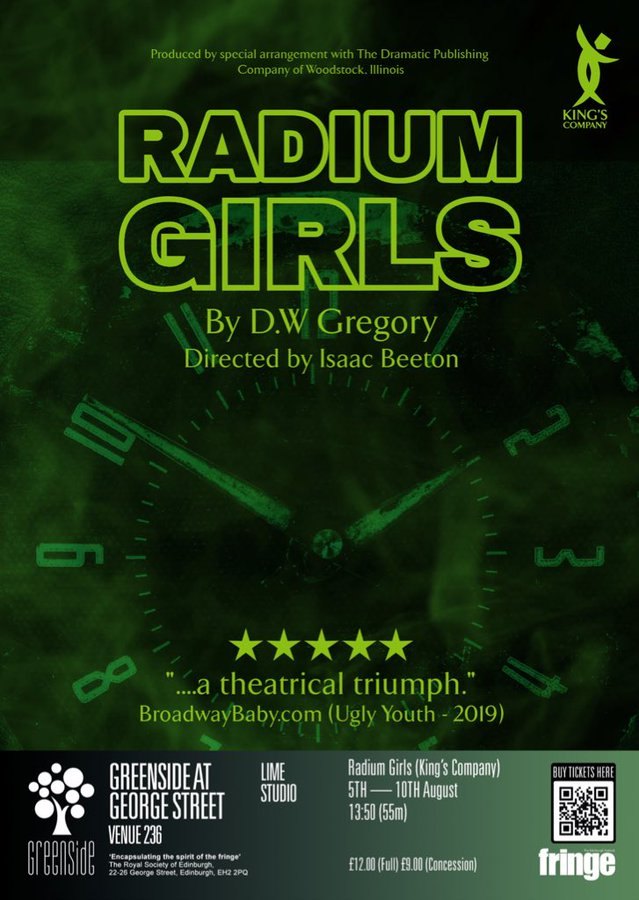
In 2024, King’s Ely school, of Cambridgeshire, U.K., presented its production of the one-act version at the Edinburgh Fringe Festival.

Other Titles

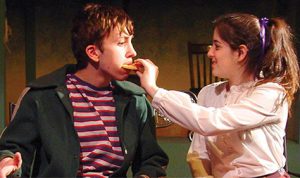
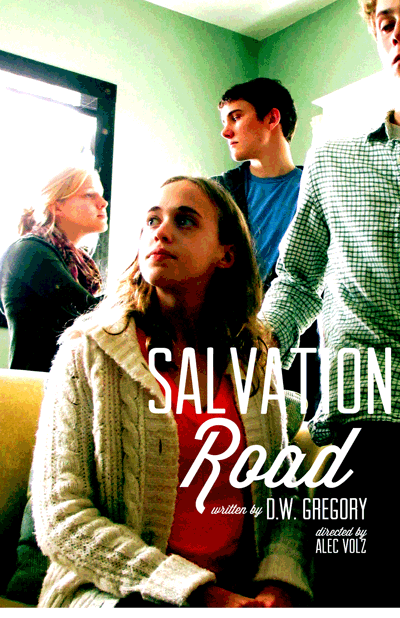
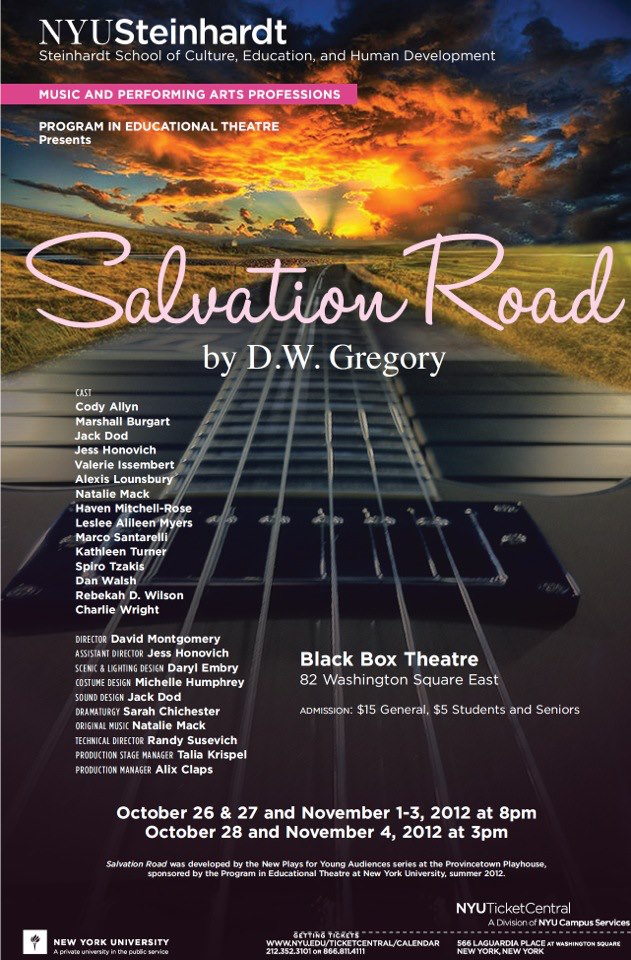
Gregory’s other plays published by Dramatic include  the black comedy The Good Girl is Gone; Salvation Road, a comic drama about a young man’s attempt to rescue his sister from what he believes is a religious cult;  Penny Candy,  a teen rom-com set in 1950s Appalachia, and  Secret Lives of Toads, a comedy about not fitting in, suitable for middle school or upper elementary groups.

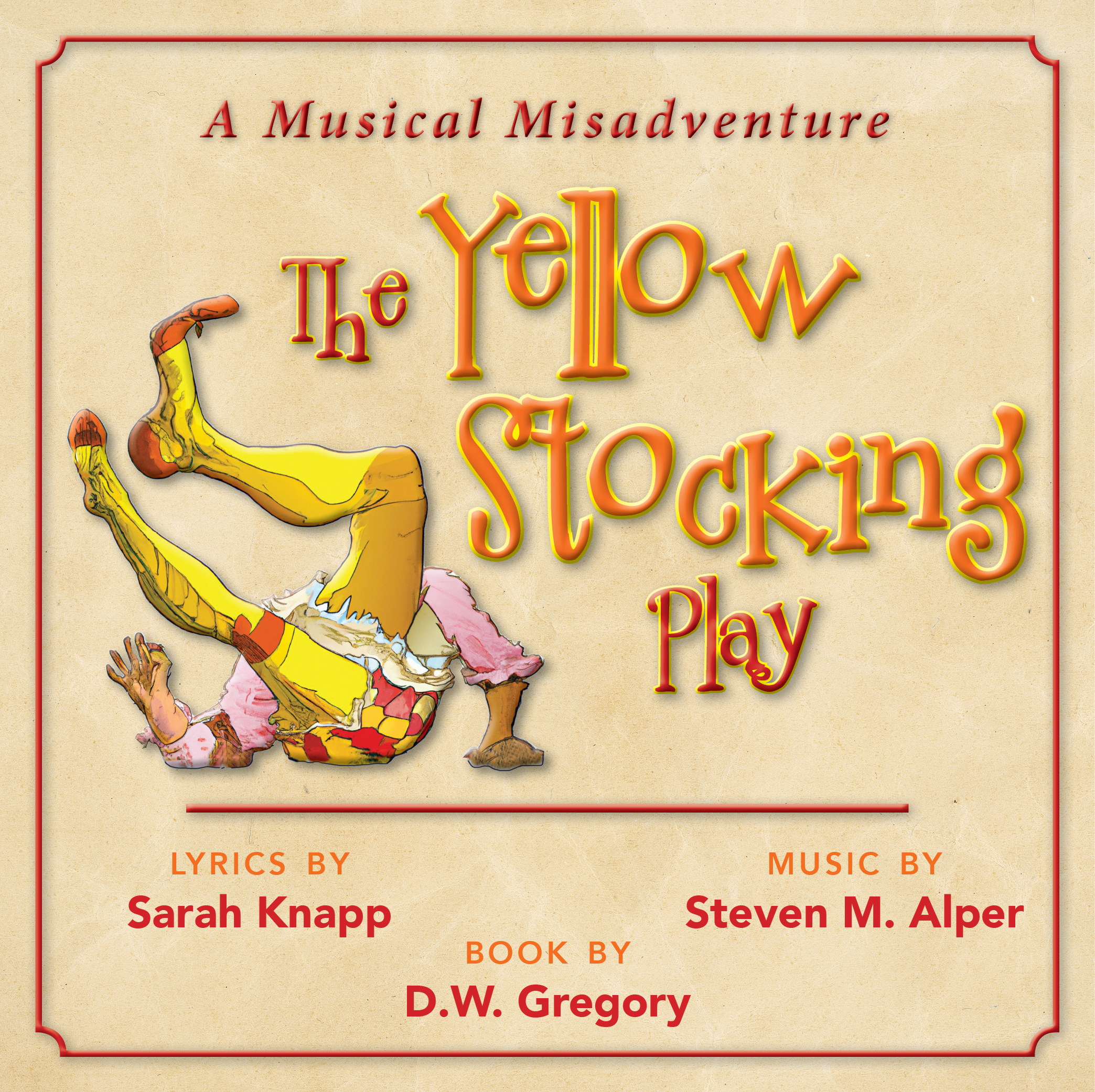
Other projects for general audiences include a musical adaptation of Radium Girls with composer Steven M. Alper and lyricist Sarah Knapp, and with the same team, a three-actor riff on Twelfth Night: The Yellow Stocking Play, which received awards for Best Musical and Best Book of a Musical in the CreateTheater 2023 New Works Festival.

Playwright D.W. Gregory to Teach at International Thespian Festival

Award-winning playwright D.W. Gregory will teach two playwriting workshops at the International Thespian Festival at Indiana University-Bloomington, June 21-26.

She will teach Cracking the Ten-Minute Play – Strategies for Writing and Teaching the Short Form on June 22 and The Well-Developed Scene: Getting Inside Your Character, on June 23.

“I’m thrilled to be going back to ITF,” Gregory said. “I’ve been continually amazed by the talent and dedication of the students I’ve met there. Some of the performances I’ve seen at the festival rival anything you’d find on professional stages.”

Gregory is best known for her drama Radium Girls (Dramatic Publishing), which has received nearly 3,000 productions around the U.S. and abroad and is among the ten most produced plays in U.S. high schools. In 2025, Playbill magazine listed it among the 20 most produced plays in the U.S.

She is also the author of other works for high school actors, including Salvation Road and Penny Candy, both published by Dramatic Publishing, and for middle schools, Secret Lives of Toads (Dramatic Publishing) and Miracle in Mudville, from YouthPLAYS.com.

The International Thespian festival is a theatre conference for members of the International Thespian Society,  a theatre honor society for middle and high school students in the United States and Canada. Held annually since 1941, the festival hosts more than 4,500 participants.

With a focus on performance, technical theatre, and education, the festival includes full-length high school productions on the Main Stage  as well as workshops led by industry professionals. Past presenters have included composer Stephen Schwartz and actress-writer Shaina Taub, author of Suffs.

The festival is  produced by the Educational Theatre Association, which is the parent organization of the International Thespian Society. Held on the Indiana University campus, it will move to Louisville, Kentucky, in 2027 to accommodate growth to more than 5,000 attendees.

Radium Girls Is Among Top 20 Produced Plays in 2025

With more than 350 productions last year, RADIUM GIRLS is among the 20 most produced plays in the U.S., according to Playbill Magazine.

Written by D.W. Gregory and published by Dramatic Publishing, Radium Girls has been a steady favorite among U.S. high schools, colleges, and community theaters for more than ten years.

“This is a terrific way to begin the new year,” Gregory said when Playbill’s list was announced in January.

“When I wrote the play originally, for Playwrights Theater of New Jersey, I had no idea it would have such a long afterlife in the amateur market. But it seems the play continues to resonate so many years later.”

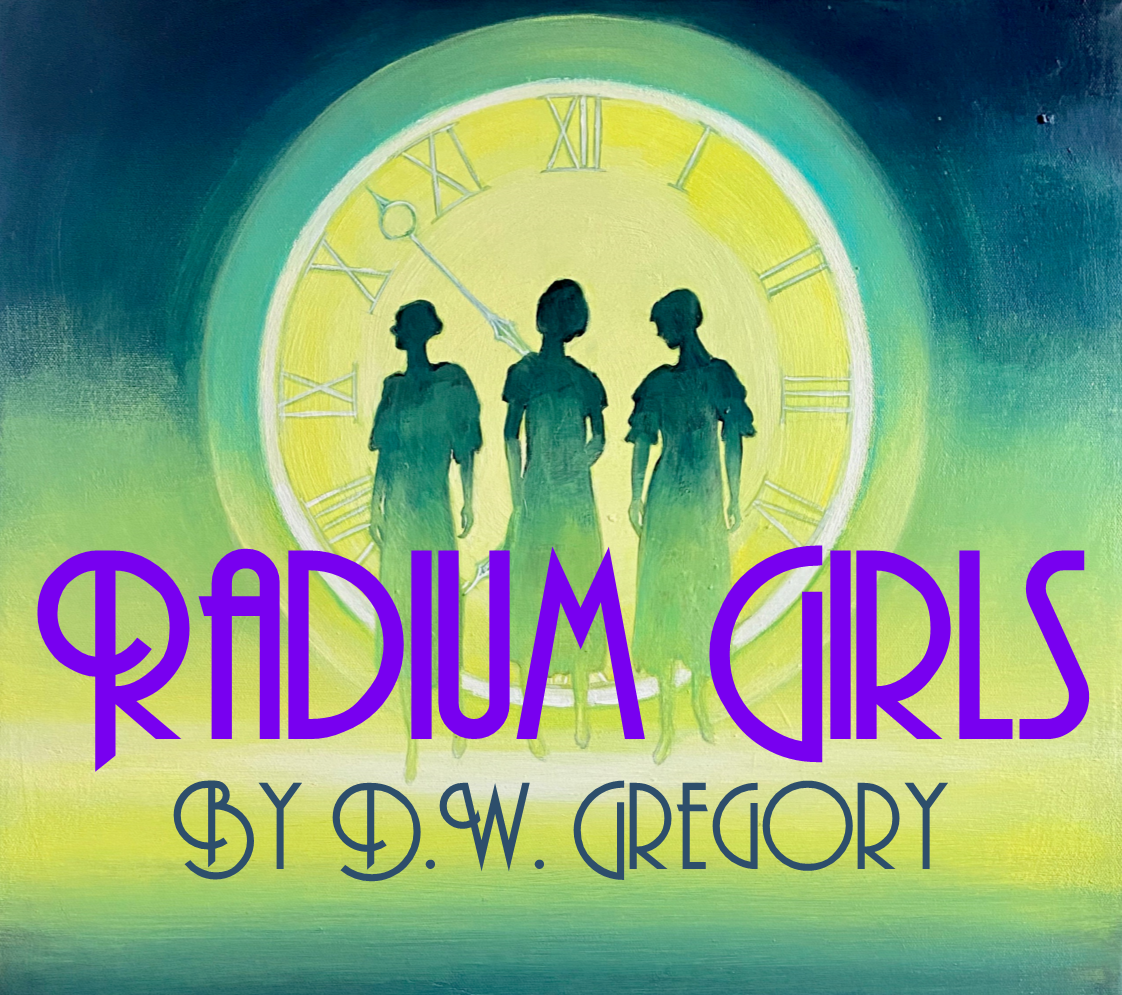
Radium Girls is based on the true story of women poisoned on the job in a New Jersey watch dial manufacturing plant of the 1920s. The play offers a wry, unflinching look at the peculiarly American obsessions with health, wealth, and the commercialization of science.

Since publication, Radium Girls has received nearly 3,000 productions throughout the U.S. and abroad. The play has been stage multiple times in Canada, the United Kingdom, Australia, and New Zealand, and has received productions in Germany, China, Singapore, and India. In 2024, King’s Company took its production of Radium Girls to the Edinburgh Fringe Festival.

Playbill compiled the  2025 list by drawing on data from hundreds of schools and community theatres that used Playbill’s program-building service, PlayBilder, last year.  Here is the full list:

  1. A Midsummer Night’s Dream
  2. Almost, Maine
  3. Little Women
  4. The Outsiders
  5. Peter and the Starcatcher
  6. The Importance of Being Earnest
  7. The Play That Goes Wrong
  8. Romeo and Juliet
  9. Radium Girls
  10. Our Town
  11. Twelfth Night
  12. Puffs
  13. Macbeth
  14. The Crucible
  15. Arsenic and Old Lace
  16. Steel Magnolias
  17. 12 Angry Jurors
  18. The Lion, the Witch, and the Wardrobe
  19. She Kills Monsters
  20. (tie) Trap and Much Ado About Nothing

For more than seven years in a row, Radium Girls has also been among the ten most produced plays in U.S. high schools, according to the Educational Theater Association.  A one-act version, cuttable for competition, is also a popular choice among U.S. high schools. In 2025, the one-act  received 34 productions.


Southern Theatre Magazine Features D.W. Gregory

In an interview with Southern Theatre Magazine, playwright D.W. Gregory talks about her award-winning new comedy A THING OF BEAUTY.

A tale of art, commerce and censorship in 1950s New England, A Thing of Beauty is the winner of the 2023 Charles Getchell New Play Award from the Southeastern Theatre Conference. It was developed in a workshop at The Barter Theater at its Festival of Appalachian Plays and Playwrights in the spring of 2023.

The script marries elements of farce and  Restoration comedy. Gregory talks about the play and her development as a writer in an interview for Southern Theatre Magazine with  Lauren Brooke Ellis, chair of the Playwriting Committee with SETC.

An excerpt:

LBE: I think one of the things that’s striking me, is talking about this balance of the levity of entertainment and compelling them to come to theatre and revealing to them this lens on the culture, which goes back to your play, “A Thing of Beauty,” which was this year’s Getchell winner. I feel this play strikes that balance really well and so I would love to ask you where the play came from in terms of inspiration and process, and what ideas were you exploring with it?

DWG: There’s a couple of triggers. One was that I had come across this photograph, it’s a pretty famous picture. It’s this woman, a proper looking matron, who’s looking through a shop window, and what she’s looking at is a nude portrait of a woman and her bare backside sticking up, she’s bending over, and the woman who’s looking through the window, her eyes are popping in horror. It’s a really funny picture. And this reminded me of an outdoor art show that happened in my home town when I was a kid. I would say 90% of it is what I would call postcard art, the sort of thing you’d see on a tourist postcard. It was all very benign, very mainstream realism. You didn’t feel like you were looking at that subject matter through an eye that is critical or an eye that has a fresh new  perspective. It was just straight on, “This is a barn, isn’t that a pretty scene? Let’s hang this up in the bathroom.”

So I thought about that art show and how that painting of a lady’s bare backside would go over with the judges. When I wrote that first scene, I just riffed, and all of a sudden this character came to me–thinking about the arts matrons, and I think every town has someone like that– wealthy women who sponsor the prizes and hold the teas and fundraisers. They ’re trying to support the arts in their community and God bless them for that, but they have a certain stifling sensibility, and suddenly Mrs. Bouffant appeared out of nowhere with her secretary.

So I went back to it and I started thinking about the other characters in the play. Who won the prize? Who were the judges? This was 2019, so a lot of stuff was in the air, you know, in the zeitgeist. And all of the conversations happening about representation in art, and so I thought, all of this sort of rolls into this story, but this is really about class. So the issue of access to art, and who can really break into these rarified worlds, and who the gatekeepers are, and the barriers to somebody who’s just trying to get by in the world.

The complete interview, along with excerpts from the play n Southern Theatre Magazine online at  https://publuu.com/flip-book/160317/1143591/page/32

D.W. Gregory Reflects on WTCM Newstalk 580’s Intermission Arts Podcast

Playwright D.W. Gregory recently joined host Michelle Perez on the Intermission arts podcast to reflect on the development and history of her most popular play, RADIUM GIRLS.

The interview with Intermission aired Saturday April 27 on WTCM Newstalk 580, serving northwestern Michigan. The interview is now available online at the following link:  Interview here.

Radium Girls has received more than 2,000 productions throughout the United States and abroad, including a recent production at Old Town Playhouse in Traverse City, Michigan, directed by  Perez .

“For so many of us, this was just a beautifully tragic journey,” Perez said of the production.

“With INTERMISSION heading into its 4th year on the air it is hard not to reflect on the over 125 interviews I’ve had the honor to conduct,” she added. “This week has been the highlight for me, personally and professionally.”

“It is a rare occasion indeed to not just speak with the playwright of a show I’ve just directed, but to have the opportunity to speak at length about their work. To say it is an honor really is an understatement. Thank you, D.W. Gregory for your art and for taking the time to speak with me.”


Radium Girls proved to be one of the most popular non-musicals in Old Town Playhouse’s recent history, Perez said, with one sell-out show and most other performances selling at nearly 90 percent capacity.

“That’s pretty rare for our area,” she said.

Old Town Playhouse was founded  in April 1960 to bring amateur theatre to northern Michigan. Its season runs  from September through May with a variety of productions. Performance areas include a 277-seat mainstage auditorium and an 80-seat studio theatre. Seasonal attendance ranges from 20,000 – 23,000 patrons.


D.W. Gregory Featured at Mile Square Theatre’s 24-Hour-Plays

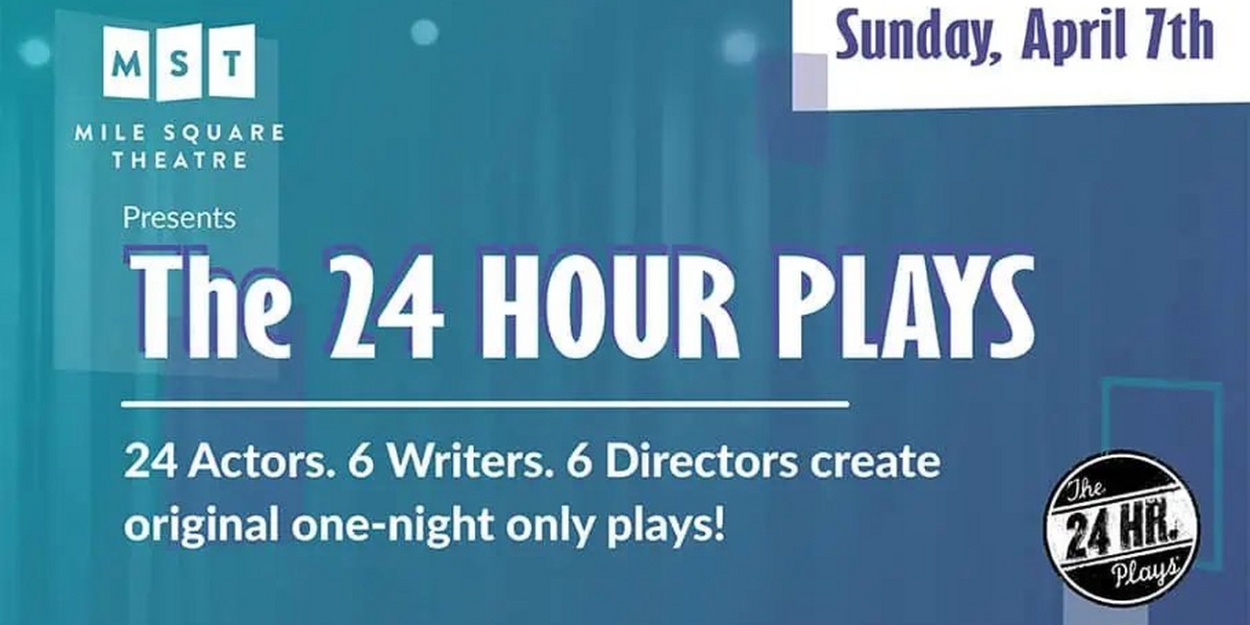
Playwright D.W. Gregory, author of Radium Girls, will be among the writers featured when The 24 Hour Plays make their New Jersey debut April 7 at Hoboken’s Mile Square Theatre.

“Absolutely thrilled to be part of this program,” Gregory said. “It looks like it’ll be a blast. As the name suggests, I’ll be cranking out pages pretty quickly. But the ultimate goal is to raise much-needed funds for the theatre’s education department.”

Established in 1995, The 24 HourPlays are a non-profit theater company that bring creative communities together to write, rehearse and perform new plays and musicals in twenty-four hours.

“Mile Square Theatre and The 24 Hour Plays honor an abiding belief in the power of creative collaboration to develop transformative multicultural voices for the theater,” said Kevin R. Free, Artistic Director of Mile Square Theatre. “We’re thrilled to be a partner to The 24 Hour Plays for its New Jersey premiere and host to a delightful mix of talents from New Jersey and New York City to make the program really sing.”

Most Produced Play

Gregory is best known for Radium Girls, which has received more than 2,000 productions throughout the U.S. and abroad. For six years in a row, Radium Girls has been one of the ten most produced plays in U.S. high schools. Other works include Memoirs of a Forgotten Man, which received a rolling world premiere through the National New Play Network and recently closed a critically acclaimed production at Thalia’s Umbrella in Seattle. In addition, The Yellow Stocking Play, a new musical comedy with composer Steven M. Alper and lyricist Sarah Knapp, won awards for Best Musical and Best Book of a Musical in CreateTheater’s New Works Festival on Theatre Row in 2023.

Other writers include Susie Felber (Host/Producer “The Hawk”),  Iraisa Ann Reilly (The Jersey Devil is a Papi Chulo), Pia Wilson (Black Bee), Marcus Scott (Sibling Rivalries), and Raakhee Mirchandani (JOURNEY TO THE STARS: KALPANA CHAWLA, ASTRONAUT). Directors include Julie Tucker, Rachel Dart (The Christmas Tree Farm) and Goldie Patrick (Paradise Blue). Musical Guests include Faye Chiao and Tasha Gordon-Solmon (Fountain of You). Additional artists to be announced.

Participating actors, writers, directors and production staff gather for the first time on the evening of Saturday, April 6th to introduce themselves and share prop and costume items they’ve been asked to bring. The writers will take inspiration from this meet and greet to write new plays overnight. In the morning, the actors and directors will receive the six new plays and team up with production staff to begin their rehearsal and tech process, with curtain at 7pm that night.

The 24 Hour Plays: Hoboken are produced by Leo Layla Diaz and Mark Armstrong in conjunction with Mile Square Theatre’s Artistic Director Kevin R. Free.  The event will honor the long-standing contributions of the Rostan Family to Mile Square Theatre with the dedication of the naming of the gallery space. Proceeds from The 24 Hour Plays: Hoboken will benefit Mile Square Theatre’s non-profit theatre making and educational programming.

For more information see the full press release at Broadwayworld.com


D.W. Gregory’s “Three Rings, No Diamonds” in PlayZoomers Festival of Imperfect Love

Tune in online Feb. 16 and 17 to see D.W. Gregory’s 10-minute comedy “Three Rings, No Diamonds,” presented live in PlayZoomers Valentine’s Day show, Festival of Imperfect Love.

“Three Rings, No Diamonds” is the tale of a relationship coach dealing with her most difficult client, a real guyish kind of guy-guy. In other words, an impossible case.

The presentation takes place live online at 7.30 p.m. EST on Feb. 16 or 9.30 p.m. EST on Feb. 17.  Tickets are $14 and can be purchased at: https://www.eventbrite.com/o/playzoomers-inc-32492851881

“I’m thrilled to be included in a PlayZoomers production,” Gregory said. “This company has set the gold standard for online productions, and it’s a real honor to be able to participate in one of their ten-minute festivals.”

The shows  and casts are as follows:

A Snake with a Ladder by Nick Maynard, directed by Brad Van Grack
With Laura Hubbard, Zachary Van Grack, Sam Entrater
Three Rings, No Diamonds by D. W. Gregory, directed by Morris Schorr
With Jerzy Jung and Adam Fox
Seven-Point-Five on Average by Kathryn Ryan, directed by Kristina Lloyd
With Doug Engalla and Patricia Ferguson
Diane Does It!  by John McEnerney, directed by Guy Kapulnik
With Sarah Brackett and Sean Dube
Secrets Hurt Less by David Valdez, directed by Jonathan McFadden
With Ben Codallo and Duncan Jay

PlayZoomers is a live, online theater company based in Massachusetts and dedicated to bringing affordable entertainment to audiences around the world.


D.W. Gregory To Be Featured Keynote Speaker at Virginia Thespian Festival.

Playwright D.W. Gregory, author of Radium Girls, will be a featured keynote speaker at The Virginia Thespian Festival, Jan. 4 – 6, 2024.

The theme of the conference is “Find Your Light.”

“That’s a topic I know well,” Gregory said. “Anyone working in theatre has to be well-practiced at finding the upside, all the time. Do this long enough and you’ll meet with a lot of frustration — but there is always an upside to every experience.”

Thespian troupes representing more than 70 middle schools and high schools across Virginia are expected to attend the three-day conference,  which will take place at the Capitol One Hall and Hilton Conference Center in McLean, Va.

Festival events will include theatre competitions, workshops, college auditions, and mainstage performances, including the presentation of a new Broadway-bound musical, SuperYou, by Lourds Lane.

Gregory is scheduled to deliver the keynote address on Friday,  Jan. 5, before the mainstage presentation at Capitol One Hall. She is also scheduled to conduct two playwriting workshops: Writing the Dramatic Action and Moving from Situation to Story. 

Gregory is the author of more than a dozen full-length plays, including Radium Girls, Memoirs of a Forgotten Man, and Salvation Road. Memoirs of a Forgotten Man received a National New Play Network Rolling World Premiere (Contemporary American Theater Festival, New Jersey Repertory Co., and Shadowland Stages). It is schedule for production in Seattle in February.

Radium Girls is among the ten most produced plays in U.S. high schools, with more than 1,800 productions throughout the United States and abroad. Radium Girls and Salvation Road are published by Dramatic Publishing.

Gregory is currently working on a musical adaptation of Radium with composer Steven M. Alper and lyricist Sarah Knapp. The same creative team won Best Musical and Best Book of a Musical for The Yellow Stocking Play at CreateTheater’s New Works Festival on Theatre Row.


D.W. Gregory Among Authors Featured in Coolest American Stories 2024

October 25, 2023 —Playwright D.W. Gregory’s  is one of 13 writers included in the 2024 edition of COOLEST AMERICAN STORIES 2024, now available in paperback.

Coolest American Stories has been called “the best current fiction anthology on the market.”

“I’m so psyched to be included in this anthology,” Gregory said. “It’s truly gratifying to know that my story will find a wider audience because of it.”

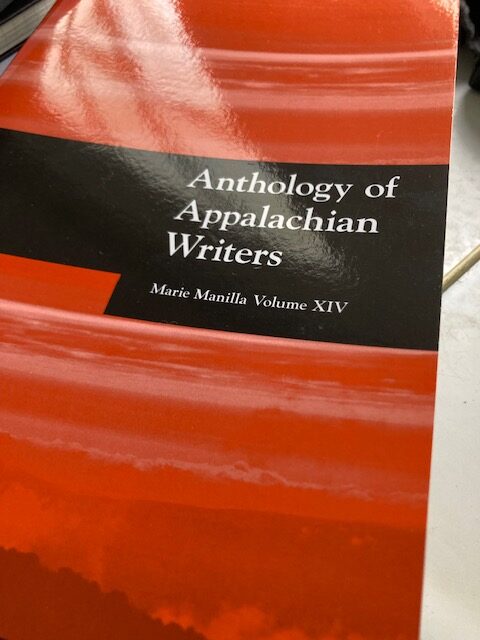
Gregory’s story “Mr. Kindness” was originally published in The Anthology of Appalachian Writers, Vol. XIV from Shepherd University and was the  2021 winner of the West Virginia Fiction contest sponsored by Shepherd University and The West Virginia Center for the Book.

Fiction as a Unifying Force

COOLEST AMERICAN STORIES 2024 is the third volume in  a series created by founding editors Mark Wish and Elizabeth Coffey.  COOLEST AMERICAN STORIES 2024 exudes its editors’ philosophy that a collection of widely appealing short stories can make for common ground that could unite rather than divide Americans.

We want America to be cool again,” the editors said in a statement posted to their website. “And we believe that the most earnest, unafraid, engaging storytelling–if it could be published and read and therefore given a chance–could make empathy and kindness fashionable again and thereby bring American coolness about. Hence our annual anthology.”

COOLEST AMERICAN STORIES 2024 features a funny yet heart-stopping story by Agatha, Macavity, and Anthony Award winning Tara Laskowski, author of the heralded One Night Gone; a suspenseful and thought-provoking story about trust by widely acclaimed playwright D.W. Gregory; and rising star Matthew Goldberg’s hilarious tale about family love in a future dominated by robotics and AI.

And since interesting storytelling―rather than a bunch of publishing credits―matters most to story-hungry readers, COOLEST AMERICAN STORIES 2024 also includes a laugh out loud page-turner about a young woman’s search for love in Paris by brand new author Hannah Mumm; a shocking dystopian tale about sacrifices necessary for survival by up-and-coming author T. N. Eyer; and a haunting rural mystery by novelist Dennis McFadden―among others in this treasure trove of unputdownable, sharply written, sometimes comic, sometimes frightening, always suspenseful stories loaded with twists and turns.

The collection is available on Kindle through Amazon.com, on Nook through Barnes & Noble and in paperback from Amazon.

The Other American
THE OTHER AMERICAN
DRAMA
“The battle for this country, even now, is waged in laboratories.”

Based on a true story.

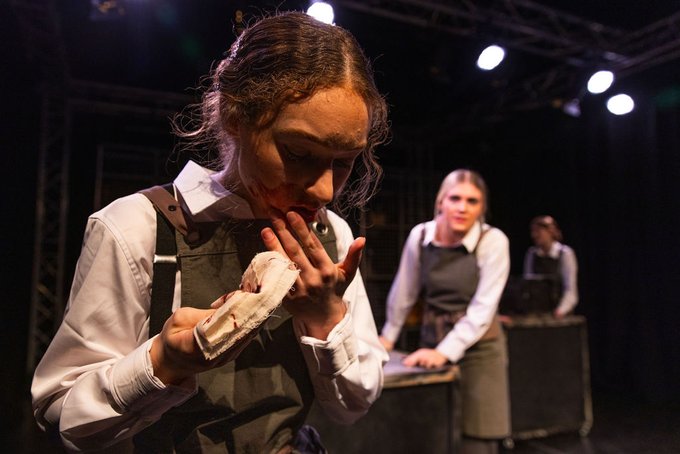
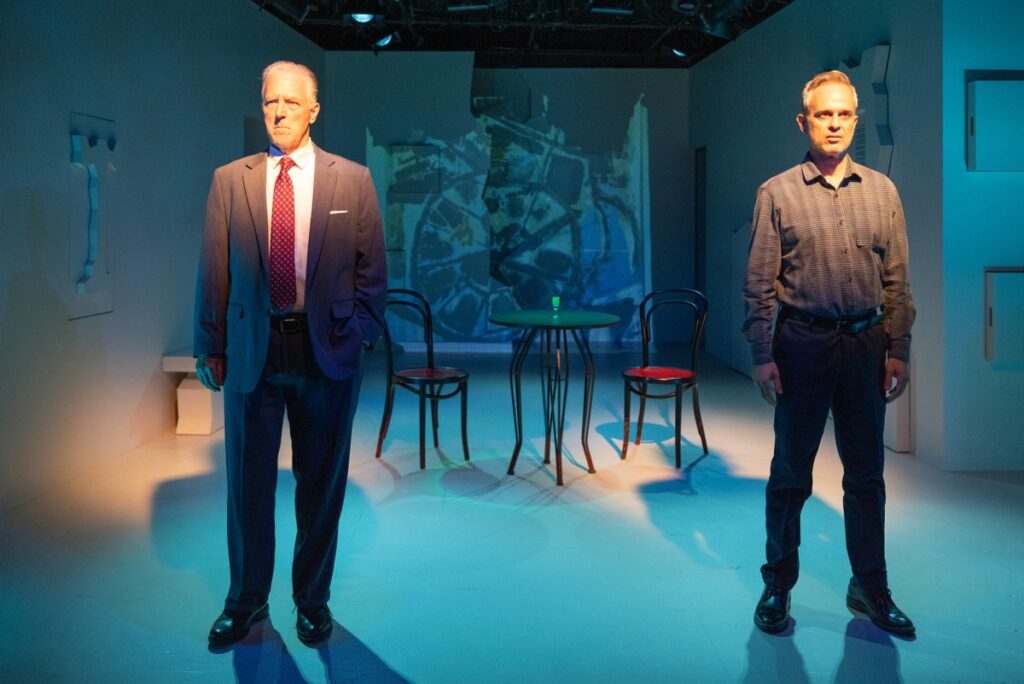
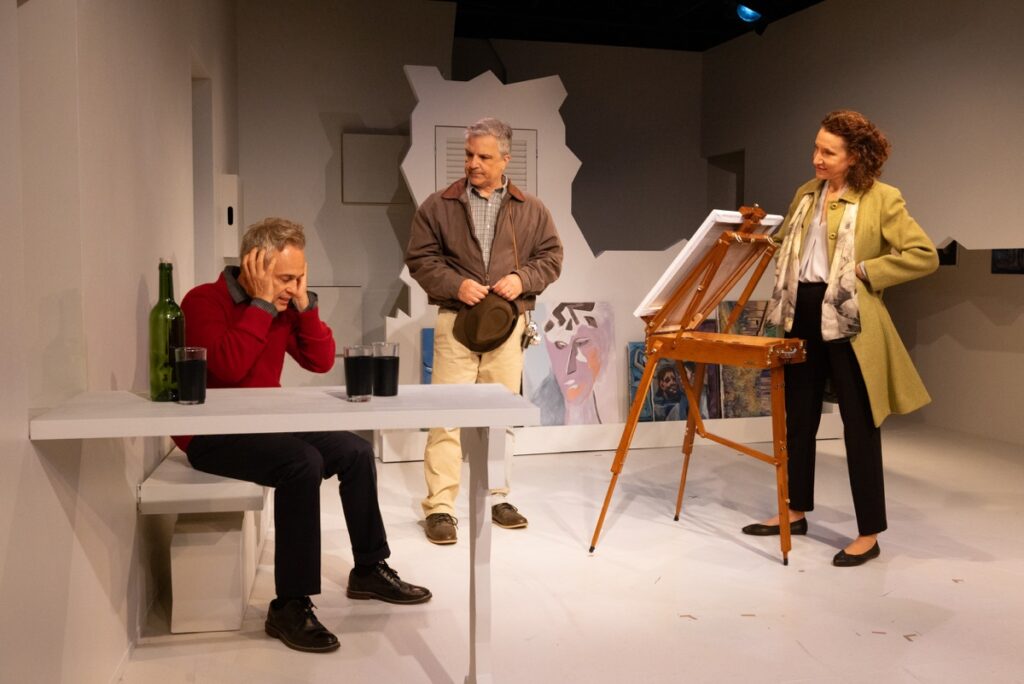
1952: Stan Glickman is a promising young artist student in Paris, living the life of his dreams. He’s fallen in love and has won a prestigious competition with a show at the Met. But a chance encounter with an American tourist catapults him into one of the darkest chapters of the Cold War—the CIA’s quest for a mind control drug.

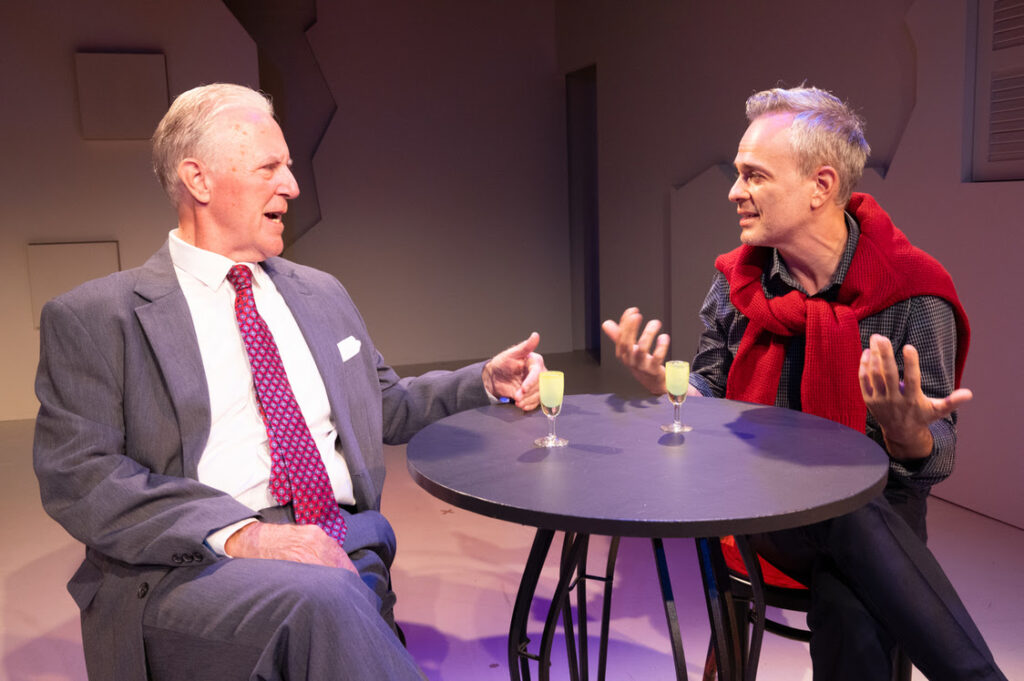
After an evening of heated political debate in a Paris café, Stan’s new companion offers to buy him a drink. Stan Glickman accepts—and immediately spirals into a mysterious mental breakdown. His life is shattered; he never paints again. 25 years later, he discovers why: The tourist was a government operative, and the drink he bought Stan was laced with LSD. By then, Stan can’t remember much about the man in the café—except that he walked with a limp. Armed with that clue, Stan embarks on a years-long effort to track down the stranger and force him out of the shadows. But The Other American is about much more than one man’s quest for justice and accountability. It is about the high human price we pay when we allow our government to reduce our fellow Americans—any American–to some expendable “other.”

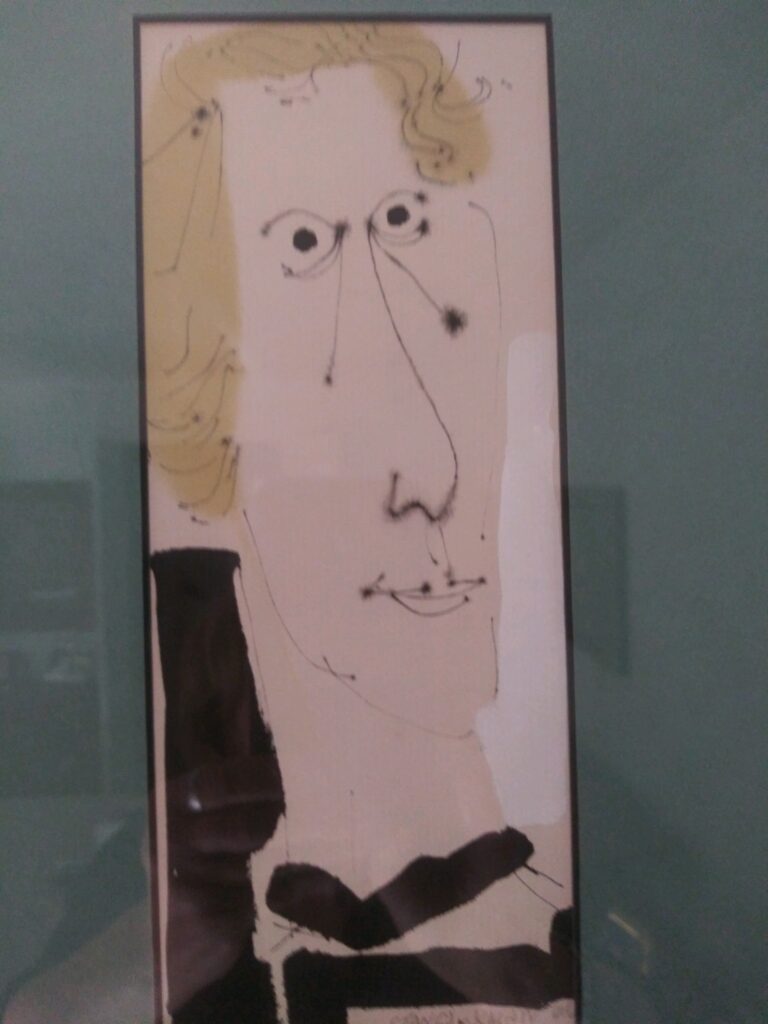
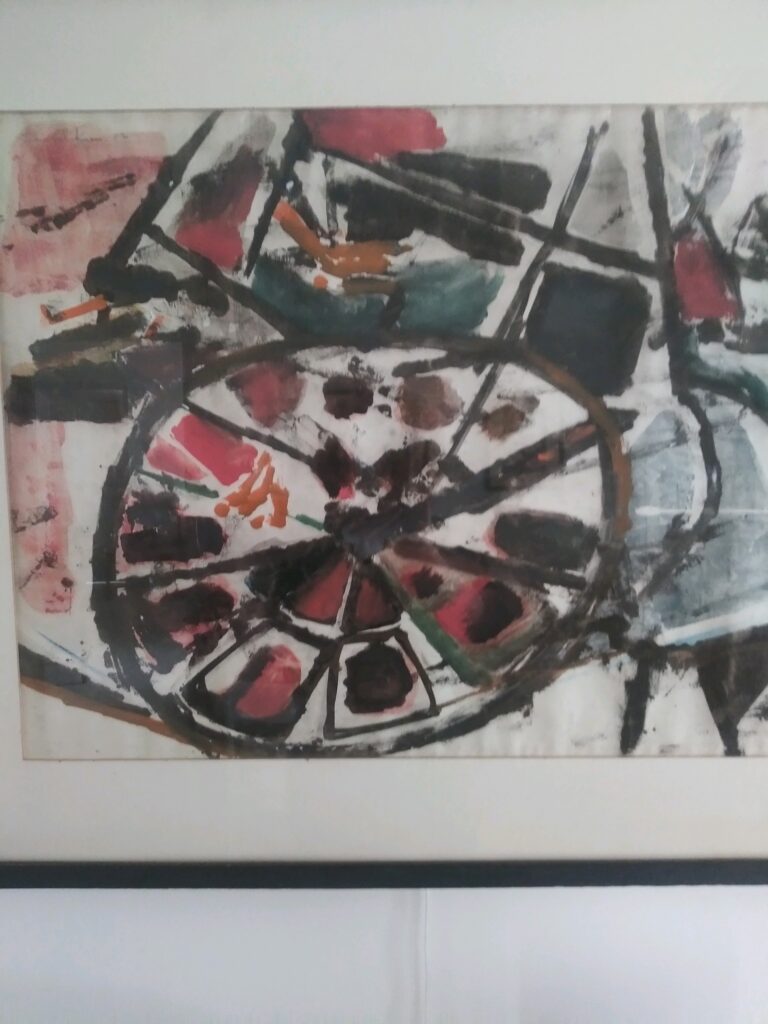
Paintings by Stan Glickman

STAN: How do I get them to understand, Sarah? Art isn’t about pretty pictures. It’s about forcing the eye. Seeing the world in a whole new way.

SARAH: Seeing the world as you see it. Through your eyes.

STAN: And then to change the world. I truly believe it, Sarah. Art can change minds. It can change the world.

SARAH: One painting at a time?

STAN: If I didn’t think so, there’d be no reason to paint.

Production Photos Credit: Andrea Phox

“Cries out to be seen by the widest possible audience.”– Out in Jersey

“Stunning… A powerful, enthralling drama.” – Broadway World

“Like seeing an experimental film played out on stage or watching a dream unfold … an amazing experience.” – New Jersey Stage

“Fascinating. Bold, New, Challenging, Outstanding. The Other American grabs your attention. The play is likely unlike anything you’ve ever seen.” – New Jersey Stage

PRODUCTION
Details

The action of the play moves between Paris, circa 1952, and the late 1980s in New York.

Written for 5 actors covering 11 roles

Run Time: 2 hours, with one intermission

Tips

Can be performed on a unit set.
2F, 3M

Details

The Other American was commissioned by New Jersey Repertory Company and received its world premiere there, Sept. 5 – 29, 2024. SuzAnne Barabas, Artistic Director; Gabor Barabas, Executive Producer

It was subsequently revised and presented in a staged reading presented by The Process Series and StreetSigns Center for Literature & Performance at UNC-Chapel Hill, 2.28.25 – 3.1.25

Cell 17 (one-act)
CELL 17
DRAMA

They say that Cell 17 is haunted. But is it a ghost that lingers there, or the burning memories of injustice done to an Irish coal miner and his wife?

PRODUCTION
Details

Run Time: 20 minutes

Tips

1 M

Host Church Triangle (one-act)
HOST CHURCH TRIANGLE
DRAMA

After months of flirtation with Jilly, Marko is ecstatic when she casually agrees to take a ride with him one balmy August night. Their destination: the old mill in the woods, beyond the Host Church, where Marko hopes love will blossom. But then they stumble upon an old man with a story to tell about the price of reckless love …

PRODUCTION
Details

Run Time: 25 minutes

Tips

1 F, 1 M

A Thing of Beauty
A THING OF BEAUTY
“Every work of art is a political statement”

What is the purpose of art? Is it to elevate our lives or shatter our assumptions? That’s the question facing the leading citizens of a sleepy New England resort when an anonymous nude takes first prize in their community’s art competition. As local gossips speculate about exactly whose bare butt is depicted in that painting, the competition’s wealthy sponsor, Mrs. Bouffant, is horrified and lobbies the judges for a more “appropriate” winner– something involving daisies or an old barn.” Horror turns to outrage, however, when she learns the winning artist is the mailman who keeps losing her deliveries. As she doubles down on her campaign for public decency, an influential New York art critic arrives on the scene, determined to shake up the big city art scene by championing this formerly unknown artist of the “working classes.”

  • Developed at Barter Theater’s Festival of New Appalachian Plays and Playwrights
  • Winner Southeastern Theatre Conference Charles Getchell New Play Award
  • Finalist, B Street Theatre New Comedies Festival
  • Finalist, Market Street Theater’s New Play Competition
  • Finalist, Theater on the Lake New Play Competition
  • Finalist, Utah Shakespeare Festival Words Cubed New Play Festival, 2025
  • Semi-finalist, Bay Street Theatre’s Title Wave New Works Festival 2024
  • Finalist, Theatre Resources Unlimited’s New Plays competition 2024
  • Runner-up, 2023 Market House Theatre New Play Competition

MRS. BOUFFANT: These, I suppose, are the results of the judging?MRS. TWINKLE: The three winning entries. The losing entries are in my car.

MRS. BOUFFANT: No, no, no, Mrs. Twinkle! We must not refer to them as the losing entries—they are simply the work of—of–

MRS. TWINKLE: Lesser artists?

MRS. BOUFFANT: Er, no. There is only one first prize, to be sure, but that does not mean second prize is second best.

MRS. TWINKLE: What does it mean, then?

MRS. BOUFFANT: We don’t want to discourage our artists, Mrs. Twinkle. If we imply that the losers are … well, losers … They might be offended and not submit again.

MRS. TWINKLE: We don’t want that!

MRS. BOUFFANT: No, indeed. As you know, the entry fee supports the prize…

PRODUCTION
Details

The Time: The early 1950s.
The Place: A small seafront town in New England

Run Time: 90 minutes with no intermission

Tips

3F, 2M

History

Staged Reading, New Jersey Repertory Co., 8.4.25

Staged Reading, CreateTheater’s New Works Festival, 5.24 – 5.25.25

Public Reading, SETC Conference, March 2023

Developed in Barter Theater’s Festival of New Appalachian Plays and Playwrights, 2.25.23

Three Rings, No Diamonds (one-act)
THREE RINGS, NO DIAMONDS
COMEDY

A relationship coach encounters her most difficult client, a real guy kind of guy — the kind of guy who is not shy about being a guy–meaning he’s desperately in need of her counsel, which he’ll probably ignore.

PRODUCTION
Details

Run Time: 10 minutes

Tips

1 F, 1 M

Some Kind of Holiday (one-act)
SOME KIND OF HOLIDAY
COMEDY

Years in captivity strain perceptions of time and metaphors for a long-married couple, but an unexpected delivery triggers a calendar–as well as an attitude–adjustment.

A 10-minute comedy for the stir crazy.

PRODUCTION
Details

Run Time: 10 minutes

Tips

1 F, 2 M or 2 F, 1 M

D.W. Gregory’s Yellow Stocking Play Is Best Musical in New Works Fest

NEW YORK–The Yellow Stocking Play, a new musical comedy by D.W. Gregory, Stephen M. Alper and Sarah Knapp, is named ‘Best Musical’ in CreateTheater’s New Works Festival.

Under the artistic direction of Off-Broadway producer Cate Cammarata in association with The Prism Stage Company, CreateTheater’s 2023 New Works Festival ran from May 23rd to June 11th at Theater Row (410 West 42nd Street).

The Yellow Stocking Play also took awards for best book of a musical, best actor (Edward Watts) and best actress (Alyse Alan Louis).

A quick-change comedy, The Yellow Stocking Play presents the efforts of  broken-down Shakespeare troupe attempting a production  Twelfth Night with only three actors. Avalanches, crocodiles and food poisoning have decimated the troupe, but nothing creates more chaos than a back-stage romance gone wrong.

“THE YELLOW STOCKING PLAY was a hilarious romp with some beautiful, melodious moments of passion lit up by the Shakespearean low comedy antics of Sir Toby Belch played brilliantly by Alyse Alan Louis,” said Ed Levy, a librettist-lyricist and one of the festival adjudicators.

With  book by D.W. Gregory;  lyrics by Sarah Knapp, and music by Steven M. Alper, The Yellow Stocking Play represents the first collaboration for the authors. Their current project is a musical adaptation of  Gregory’s widely acclaimed Radium Girls. For six years in a row, the Educational Theatre Association has named Radium Girls among the ten  most produced plays in U.S. high schools.

Steven M. Alper &  Sarah Knapp are best known  The Immigrant, with book writer Mark Harelik. The Immigrant was produced off-Broadway and nominated for two Drama Desk awards.

For more information about CreateTheater, The Experts Theater Company and the New Works Festival, go to www.CreateTheater.com or to the Festival’s homepage at www.newworksfest.org

For more details about the festival, read the full press release at Broadway World here. 

Playwright D.W. Gregory Reads Award-Winning Short Fiction at NJ Rep

Playwright D.W. Gregory reads from her award-winning short fiction May 15 in Long Branch, NJ.

“A Tale of Two Misters” is part of New Jersey Repertory’s Monday Night ‘One Stand’ series and features readings of two short stories.

In Mr. Henry, a retired schoolteacher finds love and hope in his next-door neighbor’s tomato patch.

In Mr. Kindness, a lonely farmwife’s sterile marriage is transformed by a visit from a mysterious seed salesman.

Author of Radium Girls and Memoirs of a Forgotten Man, Gregory is the 2021 winner of the West Virginia Fiction Contest and a Pushcart Prize nominee for Mr. Kindness.

“I started writing short fiction during the pandemic,” Gregory says. “When theatres were all going dark. It was hard to be motivated to write for stage in 2020. But to my surprise, I found writing short fiction opened whole new worlds of characters, ideas–even styles–that I would not have ventured into otherwise. As it turns out, some of these stories might just find their way back to the stage at some point.”

Gregory’s work has been a long-time fixture at NJ Rep. Her drama The Good Daughter premiered at the theatre in 2003. Other works produced by NJ Rep include October 1962 and Memoirs of a Forgotten Man, which was part of a rolling world premiere through the National New Play Network. The theatre has presented readings of several other full-length plays and includes three of her one-act comedies in its Theatre Brut festivals of short works.

Doors open at 6.30 for happy hour. The reading begins at 7 p.m.

For more information and to purchase tickets go to http://www.njrep.org/one_night_stands.htm


Barter Theatre Presents Staged Reading: DW Gregory’s A Thing of Beauty

Barter Theatre will present D.W. Gregory’s new comedy A Thing of Beauty  in its Appalachian Festival of New Plays and Playwrights Feb. 23 – Feb. 26 in Abingdon, VA.

The play will receive a staged reading on Saturday, Feb. 25, at 4 p.m.,  in Barter’s Smith Theatre. Directed by Derek Davidson, the reading features Tricia Matthews, Kim Morgan Dean, Ashley Campos, Justin Lewis, and Michael Poisson.

A Thing of Beauty is the story of a small town thrown into an uproar by an audacious work of art. It is one of six plays included in the festival, which focuses on new works about the Appalachian region or by authors living in the region. Other works include a new musical, Hooten Holler, by Ketch Secor,  founding member of the Grammy award-winning Old Crow Medicine Show, and new plays from Audrey Cefaly,  Phil Keeling, Catherine Bush, and Russell Nichols, who is also the winner of Barter’s Black Stories, Black Voices initiative.

A resident of Shepherdstown, WV, D.W. Gregory is best known for her drama Radium Girls, which has received more than 1,500 productions throughout the United States and abroad. Her play Memoirs of a Forgotten Man premiered in West Virginia’s Contemporary American Theatre Festival in 2018.

A Thing of Beauty: The Story

What is the function of art? It to elevate us or shake us up? The leading citizens of a stuffy seaside resort  wrestle with that question when an anonymous nude takes first prize in the community’s first annual art competition. As local gossips speculate about exactly whose bare butt is depicted in the painting, Mrs. Bouffant, the competition’s sponsor, lobbies the judges to choose a more appropriate winner, unaware that the muse who inspired the offending work is her own secretary. But the quest for propriety is upended when  an influential New York art critic arrives on the scene—and takes an undue interest in the prize-winner.

The reading is free to the public, but reservations are recommended. To reserve, go to this link.


D.W. Gregory Nominated for Pushcart Prize

Playwright and fiction writer D.W. Gregory has been nominated for The Pushcart Prize for her short story, ‘Mr. Kindness,’ a fantasy about a lonely farm wife whose life is transformed by a visit from a mysterious seed salesman.

The Pushcart Prize honors the best literary works published in American small presses.

Mr. Kindness was the first prize winner in the 2021 West Virginia Fiction Competition and appears in the Anthology of Appalachian Writers, Vol. XIV,  published by Shepherd University’s Center for Appalachian Studies and Communities and the West Virginia Center for the Book.


Four Writers Nominated from West Virginia

Gregory is one of four writers included in the anthology who were nominated for the honor. The nominations were announced Oct. 17 by Editors E.J.Wade and David O Hoffman, Editorial Advisor Marie Manilla, and Senior Managing Editor Sylvia Sherbutt.

The other nominees are:

  • West Virginia Poet Laureate Marc Harshman,  of Wheeling, WV, for “One Version.”
  • Poet Mark DeFoe, of Buckhannon, WV, for “For Those Who Suffered from Trump Derangement Syndrome and Sacked the US Capital.”
  • Poet Sue Silver, of Shepherdstown, WV, for “Deliverance.”

Most Honored Literary Project

The Pushcart Prize: Best of the Small Presses series is the most honored literary project in America – including Highest Honors from the American Academy of Arts and Letters. The series has been published annually since 1976 under the direction of editor and founder Bill Henderson.

Winners of the Pushcart Prize will be announced in April.

The Anthology of Appalachian Writers is an annual volume that  provides a venue for publication of new writers from the Appalachian region, as well as a collection of literature, photography, and scholarship that contributes to an understanding and appreciation for the region. Thus, the volume features many of the premier writers of the region each year.

Novelist Marie Manilla was the Appalachian Heritage Writer in Residence in 2021 and selected the winners of the 2021 fiction competition. Past writers in residence have included authors Silas House, Charles Frasier, Barbara Kingsolver, and Dorothy Allison.

The Anthology of Appalachian Writers is available for purchase from Four Seasons Books  116 W. German St., P.0. Box 70, Shepherdstown, WV 25443. Call (304) 876-3486 or email​4seasons.114@gmail.com


D.W. Gregory, Declan O’Rourke Honored for Work Illuminating Legacies of Trauma

INTERNATIONAL CENTER FOR MULTIGENERATIONAL LEGACIES OF TRAUMA ANNOUNCES INAUGURAL AWARDS FOR EXCELLENCE IN THE ARTS

NEW YORK—Oct. 21, 2022—The International Center for Multigenerational Legacies of Trauma (ICMGLT) is pleased to announce the 2022 winners of its Repairer awards, granted to outstanding artists whose body of work exemplifies the values of the Center in advocating for victims of trauma and educating the public about the lingering effects of trauma across the generations.

The REPAIRER EXCELLENCE AWARD goes to playwright and teaching artist D.W. Gregory, “For utilizing her exquisite, accessible playwriting to educate and inspire change by exposing the destructive legacies of systemic conspiracies of silence” — for her difficult, truth-telling play Radium Girls, about the women who were poisoned working in New Jersey’s watchdial industry, as well as many other plays that similarly explore social inequities created by the imbalance of power in American culture. Radium Girls has received more than 1,500 productions around the world. For five years in a row, it has been among the most produced plays in U.S. high schools.

The REPAIRER RECOGNITION AWARD is given to Irish singer-songwriter and author Declan O’Rourke “for applying his abundant talents and empathic knowledge to convey the horrors of the Great Hunger for future generations of Ireland and the world.” 17 years in gestation, his acclaimed Chronicles Of The Great Irish Famine presented a series of real-life accounts from this tragic period in song form. In 2021, The Pawnbroker’s Reward, his outstanding first literary work, a bestseller in Ireland, expanded on the theme and focused on the plight of one family, “Proffering reassurance in the face of inevitable sorrow,” – Jon Pareles, New York Times.

The ICMGLT is an international organization based in New York City. Its mission is to increase awareness and understanding of the multigenerational nature and legacies of trauma. It seeks to enhance assessment, effective expression, treatment and prevention and acts as a clearinghouse for literature and expertise in all related professions and traditions. In addition to awarding achievements across related disciplines, it generates and supports research.

The awards were announced by Dr. Yael Danieli, founder and executive director of the ICMGLT, at an awards ceremony Oct. 21.

“In their relevance to today’s events, the work of these artists shines a stark light on the meaning of intergenerational legacies of trauma at the core of the Center’s mission as they address the injustices and dishonesty that leads to abuse of the vulnerable—whether it be through exposure to radiation, or hunger as a weapon,” Danieli said.

More information about the Center and its work can be found at https://icmglt.org

D.W. Gregory’s Memoirs of a Forgotten Man Makes Broadway World’s Top Ten

Broadway World has named Washington Stage Guild’s  Memoirs of a Forgotten Man by D.W. Gregory one of the Top Ten best bets for theatre in Washington, D.C., this month.

The production opens May 5 at the Undercroft Theatre, 900 Massachusetts Avenue, N.W., Washington, D.C.

A 2018 hit at the Contemporary American Theatre Festival, Memoirs of a Forgotten Man portrays the determination of a totalitarian regime to erase history, and the tragic effect that has on the family of a man who can forget nothing.  It is based on the true story of a Soviet journalist with a photographic memory. In the play he finds himself an unwitting enemy of the state as Stalin sets out to erase his political enemies from the history books.


“Though the subject matter is grim, the play isn’t,” says author D.W. Gregory. “It’s infused with an absurdist kind of comedy, expressed through the political naivete of the Memory Man, who takes great pride at setting the record straight, much to the annoyance of his brother and the delight of his mother. Of course that gets them all into trouble under a regime that is hell-bent on rewriting history.

“So it is a political play, but it is also a personal story about family, friendship, and loyalty.”

Design elements are provided by Joseph Musumeci with set design, Neil McFadden with sound, Marianne Meadows with lighting; and Resident Designer Sigrid Johanessdottir with costumes.

The production is directed by Kasi Campbell, Stage Guild veterans Steven Carpenter, Laura Giannarelli, and Chris Stinson, with Lynette Rathnam making her Stage Guild debut, round out the cast.  The production  features the work of set designer Joseph Muscemi, Neil McFadden with sound, Marianne Meadows with lighting, and Resident Designer Sigrid Johanessdottir with costumes.

Performances run from May 5 – 29. Pay-what-you-can previews are May 5, 6, and 7. For more information or to get tickets, go to the theatre website or call 202-900-8788.

Memoirs of a Forgotten Man was first produced as a National New Play Network Rolling World Premiere by Contemporary American Theater Festival (WV), New Jersey Repertory Company (NJ) and Shadowland Stages (NY). For more information, please visit nnpn.org.

D.W. Gregory’s Radium Girls Receives New York Premiere

Radium Girls by D.W. Gregory will receive its New York premiere at Obie-award-winning Metropolitan Playhouse, 220 E. 4th Street, in Manhattan.

The play has been newly revised for a limited run Oct. 28 – Nov. 21, directed by Laura Livingston.

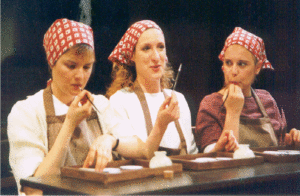
Radium Girls is based on the true story of the women who painted watch dials with luminous paint at a time when radium was hailed as a miracle cure and marketed as a health tonic. The play traces the story of one dial painter, Grace Fryer, and her quest to uncover the causes of her mysterious illness and to seek compensation from her employer, Arthur Roeder.

While the casual consumption of radioactive materials may strike modern audiences with “an amused horror,” the play’s indictments of America’s  “careless bauble- and profit-driven culture are bracing,” Metropolitan says in an essay posted to its website.

“Radium was a dazzling fad and a marketer’s dream. The companies that promoted it had far more too much to gain to be willingly transparent about the dangers their product posed to workers or consumers. The girls who believed their employers had too much to lose to question their treatment–until they had nothing left to lose at all.”

The production features  Olivia Killingsworth (The Jewish King Lear, Icebound, Within the Law) as Grace Fryer and KELLY DEAN COOPER (Thunder Rock, End of Summer, A Man’s World) as Arthur Roeder. The cast includes Metropolitan newcomers and veterans: Sydney Badway, MICHELLE BAGWELL, Grace BernardoKate Falk , MARIE LENZI , KYLE MAXWELL, DAVID LOGAN RANKIN (Poor of New York, Shadow of Heroes, Within the Law), and Benjamin Russell (The Poor of New York, The Awful Truth).

Set is by VINCENT GUNN (Shadow of Heroes, State of the Union), costumes by NYIT Award winner Sidney Fortner (The Jewish King Lear, The Climbers, A Marriage Contract), lighting by HEATHER M. CROCKER and sound by Bill Toles (Walk Hard, Shadow of Heroes).

METROPOLITAN PLAYHOUSE, beginning its 30th season with Radium Girls, explores America’s diverse theatrical heritage through lost plays of the past and new plays of American historical and cultural moment. The theater received a 2011 OBIE Grant from The Village Voice for its ongoing productions that illuminate who we are by revealing where we have come from.

Called “invaluable” by the Voice and Backstage, Metropolitan has earned further accolades from The New York Times and The New Yorker. Other awards include a Victorian Society of New York Outstanding Performing Arts Group, 3 Aggie Awards from Gay City News, 21 nominations for NYIT Awards (3 winners), and 6 AUDELCO Viv Award nominations.

Tickets can be purchased online at http://metropolitanplayhouse.org/tickets.

More information about the production is available at http://metropolitanplayhouse.org/essayradiumgirls.

D.W. Gregory a Finalist for West Virginia Fiction Competition

SHEPHERDSTOWN, WV — Playwright D.W. Gregory is one of eight finalists for the 2021 West Virginia Fiction Competition.

The competition is sponsored by Shepherd University’s Center for Appalachian Studies and Communities, which announced the finalists June 9.

Gregory was selected for her short story, “Mr. Kindness,” a fantasy about a bored farm wife whose life is transformed by a visit from a traveling seed salesman.

Gregory said she took her inspiration from a recent news item about mysterious packets of seeds that showed up unexpectedly in people’s mailboxes.

“I read speculation about the source of the seeds and warnings against planting them,” she said. “Some experts feared they were some kind of invasive species or bio-hazard, but I began to think about all the possibilities those seeds might contain. Not just hazards, but opportunities.”

D.W. Gregory is the author of more than a dozen full-length plays, including Memoirs of a Forgotten Man and Radium Girls, which is one of the most-produced plays in U.S. high schools. “Mr. Kindness” is her first foray into fiction in more than 20 years.

Other Finalists

Other finalists include Stephen Bartlett, also of Shepherdstown, for “Spirit of Kind Feather”; Julie Becraft-Shehan, Harpers Ferry, “Ties That Bind”; Lynn Swanson, Hedgesville, “Motel”; M. Lynne Squires, Scott Depot, “What He Didn’t Hear”; Sean Patrick Duffy, Wheeling, “The Wake”; and Belpre, Ohio residents Lois Spencer, a Shepherd University Lifelong Learning program member, “Wild Geese,” and Kandi Ellison, a West Virginia college student, for “Dog Days.”

All submissions are unpublished stories written by either a West Virginia resident or someone attending school in West Virginia.

Writer-in-Residence Marie Manilla

Shepherd Appalachian Heritage Writer-in-Residence Marie Manilla will review the eight submissions and choose first, second, and third place winners. Manilla will write fiction critiques for each of the finalists. Winners will be announced on August 1, and the awards will be presented by Manilla and competition partner and funder, the West Virginia Center for the Book, on September 30 during the Appalachian Heritage Festival at Shepherd.

“In some sense, each of the finalists is a winner,” said Dr. Sylvia Shurbutt, director, Center for Appalachian Studies and Communities.  “Everyone has this extraordinary opportunity to receive a priceless piece of literary advice from Manilla.”

The complete announcement can be found on the Shepherd University website.

For information about the competition or to learn more about Manilla, see https://www.shepherd.edu/ahwirweb/manilla/.

“Three Rings, No Diamonds” Featured at Magnetic Theatre of Asheville

“Three Rings, No Diamonds,” a new ten-minute comedy by D.W. Gregory,  will be featured on a bill of short works at Magnetic Theatre of Asheville, N.C., June 11-12.

The play is a two-character piece about a relationship coach and  her most difficult client.

“He’s a real guy kind of guy,” Gregory says of the client. “The kind of guy who is not shy about being a guy– meaning he’s desperately in need of her counsel, which he’ll probably ignore.”

As for the coach?

“She takes no prisoners. But she does take Venmo.”

“Just a frothy bit of fun,” Gregory adds.

Magnetic Theatre’s One Act Play Festival includes 14 one acts, broken up into two shows. Gregory’s comedy will be performed Friday, June 11 at 7.30 p.m. and Saturday, June 12, at 4 p.m.

The bill of one-acts also includes:

  • Banana Gun by Mary Beth McNulty
  • Memory is a Thief by Sean Murphy
  • A Splash of Red by Kym Fraher
  • Dis/Connect by Sage Martin
  • When I Fall In Love, It Will Be… by Susan Middaugh
  • Lighted Fools by Bridget Grace Sheaff

For more information on the performances or to purchase a ticket, go to the theatre website.

D.W. Gregory included in 7 Talented Contemporary Playwrights

PRESS RELEASE:

LOS ANGELES– Playwright D.W. Gregory, author of Radium Girls and Memoirs of a Forgotten Man, has been included in a video wiki “Seven Talented Contemporary Playwrights,” by Ezvid Wiki.

The seven featured writers are: Jacqueline E. Lawton, Jen Silverman, Gwydion Suilebhan,  D.W. Gregory, Matthew Paul Olmos, Madhuri Shekar, and Anne Garcia-Romero.

Gregory is cited for her most-produced play, Radium Girls, which has received nearly 1,200 productions worldwide since its publication.  She recently closed a National New Play Network rolling world premiere of Memoirs of a Forgotten Man with the Contemporary American Theatre Festival, Shadowland Stages, and New Jersey Rep.

“It’s quite an honor to be included,” Gregory said. “These are not only exceptionally talented writers, they are also lovely people who’ve done a great deal to promote the work of their fellow playwrights.

“Jacqueline Lawton especially has been a wonderful friend and mentor to me,” she said. “And Gwydion has been an advocate  and innovator through the creation of the National New Play Network’s New Play Exchange, which thousands of playwrights and theatres have found to be an essential resource.”

Gregory’s plays are posted on the exchange at https://newplayexchange.org/users/139/dw-gregory

Ezvid Wiki was the world’s first video wiki and is now among the top 3,000 websites in the United States. Its YouTube channel has over 500,000 subscribers, with nearly 300 million views since its founding.

The wiki can be found at  https://wiki.ezvid.com/m/7-talented-contemporary-playwrights-JZwWbVJk8EymC

Metropolitan Playhouse Presents New York Premiere of Radium Girls

Metropolitan Playhouse, an Obie-award-winning theater, will present the New York premiere of D.W. Gregory’s RADIUM GIRLS, newly revised for a limited run from March 19 through April 12, 2020, at the Playhouse home: 220 E 4th Street.

Laura Livingston (State of the Union, The Jazz Singer) directs an ensemble of 10 actors doubling into more than 30 roles..

Previews begin Thursday, March 19. Opening night is Saturday, March 21. Performance times are Thursdays, Fridays, and Saturdays at 7.30 p.m., Sundays at 3 p.m. Talk-backs will follow each  Sunday performance.

The story:

Radium in 1920: a miracle discovery with limitless applications, from iridescent paints and make-up to cancer treatment and health tonics. The craze for radium in the late 1910s and 20s meant big business for companies across the US. It also brought exciting opportunities to painters of illuminated watch faces: dexterous young women, often under 18, who kept the paint brushes pointed and supple with their lips. But when more and more of the girls found their bodies literally falling apart, their struggle for recognition and compensation pitted them against some of the most successful corporations of the day. Their battle set the model for future worker’s protection laws in the United States, but not in time to save their own lives.

Read the full article at Broadway World.

Radium Girls Makes EDTA’s Top Ten List Again

For the second year in a row, Radium Girls, by D.W. Gregory, has been named one of the ten most-produced plays in U.S. high schools, edging up to the No. 8 slot from No. 10 in the 2017-18 school year.

Radium Girls at Randolph Macon High School.

The Educational Theatre Association issued the results of its annual survey of 3,000 high schools Aug. 1. The list of the most-produced plays, musicals and one-acts can be found on the EDTA’s website.

Radium Girls is based on the true story of the young women who worked in New Jersey factories, painting watch dials with radium-laced paint to create glow-in-the-dark timepieces. It was originally produced by Playwrights Theatre of New Jersey. Since publication by Dramatic Publishing, the play has received more than 1,000 productions in the U.S., Canada, and abroad.

The story:

Radium Girls traces the efforts of Grace Fryer, a dial painter, as she fights for her day in court. Her chief adversary is her former employer, Arthur Roeder, an idealistic man who cannot bring himself to believe that the same element that shrinks tumors could have anything to do with the terrifying rash of illnesses among his employees. As the case goes on, however, Grace finds herself battling not just with the U.S. Radium Corporation, but with her own family and friends, who fear that her campaign for justice will backfire. Written with warmth and humor, Radium Girls is a fast-moving, highly theatrical ensemble piece for 9 to 10 actors, who play more than 30 parts—friends, co-workers, lovers, relatives, attorneys, scientists, consumer advocates, and myriad interested bystanders. Called a “powerful” and “engrossing” drama by critics, Radium Girls offers a wry, unflinching look at the peculiarly American obsessions with health, wealth, and the commercialization of science.

More information about the play can be found at Dramatic Publishing’s website, https://www.dramaticpublishing.com/radium-girls. A one-act adaptation for competition purposes is also available from Dramatic Publishing.


D.W. Gregory Talks to Broadway World about Memoirs of a Forgotten Man

Broadway World’s Marina Kennedy interviews D.W. Gregory about her upcoming production of Memoirs of a Forgotten Man,  inspired by the true story of a Soviet journalist with the gift of total recall.

New Jersey Repertory Company presents The National New Play Network Rolling world premiere from August 15-September 15, 2019. Directed by James Glossman, the play stars Amie Bermowitz, Steve Brady, Andrea Gallo, and Benjamin Satchel.

I talk about the inspiration for the play, its relevance to American audiences, and the creative team bringing it to life.

Click here for the full Q and A.


Memoirs of a Forgotten Man at New Jersey Repertory
A Soviet journalist with the gift of total recall. A psychologist seeking to rehabilitate herself. A government censor with a secret past. Their fates become entwined as victims and collaborators in Stalin’s campaign to rewrite public memory. Long before fake news was a trending topic, it was called propaganda. And in the Soviet Union, it was the grease that kept Stalin’s machinery of terror in motion. A haunting and suspenseful political thriller based on a true story.
Tickets, Subscriptions, Reservations
Memoirs of a Forgotten Man  runs August 15 – September 15, 2019. Previews are Thursday and Friday, August 15 and 16 at 8:00 PM, and Saturday, August 17 at 3:00 PM. A special talk-back with the playwright and director will be held after the first preview, Thursday, August 15. Opening night with reception is Saturday, August 17 at 8:00 PM. Regular performances are Thursdays and Fridays at 8:00 PM; Saturdays at 3:00 PM and 8:00 PM; Sundays at 2:00 PM. Tickets are $50 (opening night with reception, $60; premium seating + $5). Tickets are subject to a service charge. Annual subscriptions are $225 per person. 3-show Flex Passes, redeemable on Thursday and Friday nights, are $99 per person. For tickets or additional information call 732-229-3166 or visit www.njrep.org.
Bloomsbury Releases ‘Memoirs of a Forgotten Man’ in CATF Anthology

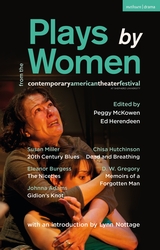
Memoirs of a Forgotten Man is now in print! London-based Bloomsbury Press recently announced the release of “Plays by Women from the Contemporary American Theater Festival,” under its Methuen Drama imprint.

The anthology includes five plays by women playwrights produced at CATF.  The collection is edited by CATF’s Managing Director Peggy McKowen and Artistic Director Ed Herendeen and features an introduction by Pulitzer Prize-winner Lynn Nottage.

In addition to Memoirs of a Forgotten Man, the anthology includes Gidon’s Knot,  by Johnna Adams; The Niceties, by Eleanor Burgess; Dead and Breathing, by Chisa Hutchinson, and 20th Century Blues by Susan Miller.

Bloomsbury describes the collection as follows:

“This anthology of work provides plays that speak to one of the most compelling virtues of artists everywhere – freedom of speech. A necessary volume of women playwrights’ work, ranging from a two-time Obie Award-winning author to emerging writers just beginning their careers, it represents a group of women who vary in age, race and sexual orientation and offers an invitation to artistic leaders, scholars and students to embrace gritty, thought-provoking new dramatic work.”

Memoirs made its world premiere at CATF in July 2018 as part of a National New Play Network rolling world premiere. It will be produced next at Shadowland Stages in Ellenville, N.Y., in June 2019, under the direction of Brendan Burke; and in August 2019, at New Jersey Repertory Co. in Long Branch, N.J., directed by James Glossman.


Radium Girls Makes Top 10 List for High School Drama, NPR

I am thrilled to report that Radium Girls was among the 10 most-produced full-length plays in U.S. high schools in 2017-18, according to the Educational Theatre Association’s annual survey, released Aug 1.

As a result, National Public Radio has updated its report on the most-popular high school plays and Radium Girls gets a mention.

EDTA, publisher of Dramatics Magazine, polls 4,000 high school drama teachers each year. Making the list was not a complete surprise — last year, there were more than 150 productions of Radium Girls around the country.

The full survey results can be found at this link.


The Collaborations That Pay Huge Dividends
David McElwee in CATF’s ‘Memoirs of a Forgotten Man’ (photo by Seth Freeman)

In working on a new play, I find that one of the questions I frequently get from audiences is whether the production lives up to my expectations. The expected answer is a critique of how the acting and directing have transformed my words into something I never intended.


Often they are surprised to hear that the staging far exceeds any hopes or ideas I ever had for the piece. It’s almost invariably a much better play than I wrote because of the contributions of all the other artists who’ve brought it to life on stage.

(more…)

National New Play Network Announces Rolling World Premiere for Memoirs of a Forgotten Man

The National New Play Network announces the rolling world premiere for Memoirs of a Forgotten Man, starting with the acclaimed production at the Contemporary American Theatre Festival in Shepherdstown, W.Va., and continuing with productions at Shadowland Stages in Ellenville, N.Y., and New Jersey Repertory Co., in Long Branch, N.J., in 2019.

Read the full release here.

Joey Parsons and David McElwee in Memoirs of a Forgotten Man at CATF. (photo by Seth Freeman)


Washington Post: ‘Memoirs’ is ‘a suspenseful and carefully wrought what-if’
David McElwee in CATF’s ‘Memoirs of a Forgotten Man’ (photo by Seth Freeman)

The Washington Post counts ‘Memoirs of a Forgotten Man’ among the ‘terrific’ scripts featured at the Contemporary American Theatre Festival through July 29, noting that“’Memoirs’ resonates in a time when facts fall victim to partisan passions”:

“The plays at this year’s Contemporary American Theater Festival speak fervently about the power of memory. Whether it’s because of Proustian cookie consumption or because divisive times and extreme weather inspire soul-searching about the past, the six works currently on view at this town’s nationally known new-play showcase comment on memory’s ability to dominate and disrupt the present.

“The productions have other traits also worthy of note: Five of the six are world premieres. Several of the scripts are terrific. And, as is typical at this festival, the acting and production values are top-notch.”

Check out Celia Wren’s full review of the festival here.


Radium Girls Closes Sellout Run at Mana Little Theatre
“The Sudden Sixties” Featured in The Ferber Project
Secret Lives of Toads
COMEDY

A comedy about fitting in and breaking free.

Poor Harvey faces his first day at a brand new school, where things look none too inviting. The cool kids have already staked out their territory on the playground, and there’s no room in their cliques for nerds or dweebs or other kids with weird attitudes—like that shy girl, Cissy, who never talks or that tough girl, Barrie, who plays with frogs. When Harvey befriends these luckless souls, he is suddenly thrust into the middle of a simmering feud between them and the snootiest girl in school. Meanwhile the frogs in the science lab have their own ideas about what it means to feel stuck.

A one-act comedy suitable for elementary and middle school performers.

Originally produced by Imagination Stage as part of its Speak Out on Stage program. It has since received multiple productions in schools around the United States.

Available from Dramatic Publishing.

  • Published by Dramatic Publishing
PRODUCTION
Details

A one-act comedy suitable for elementary and middle school performers.

Run Time: 45 minutes

Tips

Cast of Characters:

  • 18 F, 5 M (expandable to 38, 15 of either gender)
History

Originally produced by Imagination Stage as part of its Speak Out on Stage program. It has since received multiple productions in schools around the United States.

What Goes Around
WHAT GOES AROUND
COMEDY

The trickle-down theory of pushing people around. A ten-minute play about the way bullying behavior is passed down and passed along – and not restricted to the playground. Commissioned by Dramatic Publishing and included in its anthology, The Bully Plays.

Published as part of The Bully Plays by Dramatic Publishing.

PRODUCTION
Details

The play is expandable and playable with a single sturdy table which could double as desk, dining room table, bus, etc.

Run Time: 10 minutes

Tips

Cast of Characters:

The play can be performed by as few as four or as many as eight to 10 actors covering the following roles:

  • EVERETT BLEDSOE (THE BOSS), a sales director for a beauty products supply company.
  • SMEDLEY, an ineffective salesman for the company.
  • JUNIOR, Smedley’s son, 12.
  • DARLA, his daughter, 14
  • MARCIE, a girl on the school bus.
  • THE GANG – as much a mentality as a group, to be performed by one to three or more actors.
  • NICKLES, a school administrator
  • ANNOUNCER
History

Multiple productions, including Omaha Theatre Company.

Penny Candy
PENNY CANDY
COMEDY
“There's gotta be somethin' wrong with somebody who can't make a decent strawberry jam.”

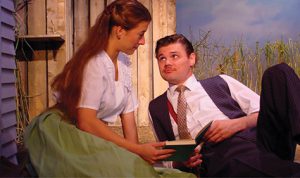
1952. Sixteen-year-old Neely Cole, awkward and tongue-tied, has always suffered a poor comparison to his much-admired older brother, Aidan, now fighting a distant war in Korea. Aidan writes poetic letters home to his long-time girlfriend Regina Miller, who is unaware that her boyfriend has recruited Neely to play secret go-between with a different girl, Emily Abbott. At first Neely considers the assignment a game to relieve his boredom, but as Emily’s attachment to Aidan grows, he begins to struggle with his own nagging conscience and an unspoken wish to claim Emily for himself.

Originally produced by Imagination Stage as part of its Speak Out on Stage program, Penny Candy has since been produced by youth theaters and high school drama groups in the United States and Canada.

PRODUCTION
Details

Penny Candy is a small cast comedy stage play about young people tipping their toes into the turbulent waters of romance for the first time. Set during the Korean War, in a rural part of Pennsylvania, the play explores themes of personal responsibility and integrity, but it also touches on the devastating impact of the Red Scare and Cold War era paranoia. For these reasons, Penny Candy can be a good fit for school theater in search of a small cast comedy, as it provides an entertaining vehicle for introducing young audiences to this pivotal era of American history.

Run Time: 75 minutes

Tips

Cast of Characters:

  • 7 roles for females and 2 roles for males, ages 12 to 17
  • Appropriate for middle school and high school performing groups as well as youth theater and Theatre for Young Audiences
History

Originally produced by Imagination Stage as part of its Speak Out on Stage program, Penny Candy has since been produced by youth theaters and high school drama groups in the United States and Canada.

Miracle in Mudville
MIRACLE IN MUDVILLE
COMEDY

A comedy about time-traveling little leaguers.

Casey is the worst ballplayer in the Mudville Little League, the butt of jokes and an embarrassment to his Dad, who brags of his glory days in the outfield. But he is not alone in feeling inadequate; his friends Murphy and Hector suffer by comparison to their parents, too. Then a chance encounter with the ghost of the town’s late librarian throws Casey and his friends into a time warp, where they discover that some of their parents’ big adventures didn’t quite happen the way they said.

Miracle in Mudville is a riff off the poem, Casey at the Bat, but this Casey is a completely average little leaguer carrying a heavy burden of trying to live up to his Dad’s fond memories of his glory days on the field. Developed for Imagination Stage’s Speak Out series, this large cast comedy has been performed with as many as 50 students. Exploring themes of parental pressure and the burden of expectation on heavily scheduled young people today, the play is an excellent choice for school theater, providing a humorous vehicle for dialogue among students, parents, and teachers.

Published by YOUTHPlays.com

  • Published by YouthPLAYS.com
PRODUCTION
Details

Miracle in Mudville is a riff off the poem, Casey at the Bat, but this Casey is a completely average little leaguer carrying a heavy burden of trying to live up to his Dad’s fond memories of his glory days on the field. Developed for Imagination Stage’s Speak Out series, this large cast comedy has been performed with as many as 50 students. Exploring themes of parental pressure and the burden of expectation on heavily scheduled young people today, the play is an excellent choice for school theater, providing a humorous vehicle for dialogue among students, parents, and teachers.

Run Time: 65 minutes, no intermission

Tips

13-17 F, 5-11 M (3 roles for either gender)
Most roles are age appropriate for middle school, though it is possible to cast older actors in the roles of the adults.

Cast of Characters:

  • 5-11 males and 13-17 females
  • There are 3 roles for either gender
  • Most roles are age appropriate for middle school, though it is possible to cast older actors in the roles of the adults.
History
  • Originally produced by Imagination Stage as part of its Speak Out on Stage Program, this large cast stage comedy has been a popular choice for middle school drama groups.
  • Tibbits Stage, of Coldwater, MI, produced the play with more than 50 kids.
Five-Cent Girl (one-act)
FIVE-CENT GIRL
DRAMA
“We live in dreams, don't we?”

1896. Washington, D.C. An undercover detective discovers the doomed romance that drove a fellow police officer to murder his own captain. But will the sweet memories surrendered by a lonely dance-hall girl be enough to save his friend from the gallows?

Published in: 30 Plays for Passionate Actors

  • Published in Thirty Short Plays for Passionate Actors (All-Original Play Publishing, 2017).
PRODUCTION
Details

THE TIME: 1896, spring.

THE PLACE: A corner pub in an Irish slum. This one is the Swampoodle section of Washington, D.C., once notorious for vice, crime, and ignorance … now long gone.

Run Time: 10 minutes

Tips

1 F, 2 M

Cast of Characters:

  • ANGUS, a barman.
  • CUSTOMER, a mysterious gentleman with a secret agenda.
  • SILE (pronounced ‘Sheila’), an Irish immigrant, anywhere between 19 and 30.
History
  • Commissioned and produced by Rorschach Theatre, Washington, D.C., March 2012
October 1962
OCTOBER 1962
DRAMA
“It's a terrible thing when children lie to their parents.”

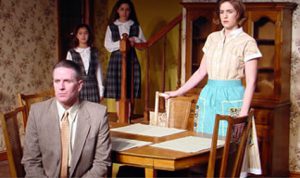
A paroled killer’s return to his home town creates havoc for a neighboring family already struggling with Cold War paranoia.

Fourteen-year-old Jeannie Timmons and her little sister Nan are fascinated by the boy down the street—but he’s not just any teenager with a motorcycle. He’s a convicted killer whose return to the old neighborhood has sent their mother into a panic and their father into an unexplained crisis of conscience. How far will their parents go to protect them from a danger that might not quite exist? Set during a time of Cold War paranoia, this comic drama explores the necessity of deceit in the pursuit of absolute security.

  • Finalist, Bloomington Playwrights Project, 2011 Woodward/Newman Award

“Gregory makes October 1962 one of those all-too-rare accomplished plays where theatergoers are sure they can guess what really happened, only to find that the playwright has led them down the wrong path of the maze.” – Newark Star Ledger

“An unnerving new drama … a decided Hitchcockian fabric to the steely narrative.” – Daily Variety

“Is it too early to proclaim the Shore area’s best new play of 2007?
For their first mainstage offering of the year, the people of New Jersey Repertory Company have dropped something of a quiet bombshell — a production that sets the bar high for everything to follow.” – Asbury Park Press

PRODUCTION
Details

The action takes place in the home of the Timmons family in two weeks in October 1962.

Run Time: 2 hours

Tips

Cast of Characters:

3 F, 1 M

  • Jeannie Timmons, 14
  • Nan, her younger sister, 11
  • David Timmons, their father, 39
  • Laura Timmons, their mother, 36
History
  • Originally produced by New Jersey Repertory Co. Directed by Matthew Arbour.
The Good Daughter
THE GOOD DAUGHTER
DRAMA
“Just cause you was born in a place don’t mean you belong in a place.”

One man would tame a raging river, another his rebellious child. Neither can foresee the consequences. An epic story of love and defiance in World War I Missouri.

Shades of Lear color this stage drama of Ned Owen, a pious Missouri farmer whose dearest hope is to see his daughters settled and his family farm pass to the capable hands of one of their sons. In the summer of 1916, middle daughter Cassie appears about to concede to his wish that she wed a neighboring farmer–even though they both know her older sister Esther would make Rudy Bird a better wife. What can Ned do? Esther has been rendered unfit for marriage by childhood polio, and his compliant youngest daughter, Rachel, is still a child at 14. But one hot summer day, a local merchant’s son arrives with an astonishing idea—to build a system of levees that would bring the ever-flooding Missouri under control. Though Ned laughs him off, Cassie is enchanted, finding in the young man’s passion a focus for her own restless nature. But as she is drawn towards him, more powerful forces, in the form of a worsening drought and a distant war, threaten to unravel her best laid plans for happiness.

“D.W. Gregory’s affecting family drama The Good Daughter boasts a flavorful, cinematic sweep. It’s a sprawling tale of small-town family conflict centering on a prodigal daughter who inadvertently brings despair upon her return home. ” – Variety

“Like some downstream eddy, The Good Daughter draws you in within seconds.” – Asbury Park Press

“Gregory’s sharply written slice of Americana … resists turning her people into cornpone caricatures, crafting instead, an intelligent script that challenges its cast and crew to deliver something truly extraordinary.” – Asbury Park Press

“… a multi-faceted, thought-provoking traditional American play which stirs echoes of Eugene O’Neill.” – Bob Rendell’s New Jersey

“D.W. Gregory has written a classically American play that really digs deeply into the roots of our society and societal expectations.” – Tri-City News

“Under Jason King Jones’ un-fussy direction, the deluge of romance, regrets, recriminations, and rebellious behavior that propel The Good Daughter take an almost retro dramatic course. But it is a course that, for all its contrived arteries, is precisely and skillfully constructed.” – Curtainup.com

PRODUCTION
Details

This thought-provoking drama stage play examines life, love and rebellion in rural America during WWI. This re-examination of the American Dream and its use of Shakespearean themes make this drama suitable for university and educational theater as well as professional theater. Exploring the themes of environmental and emotional destruction through human efforts to control nature and to control each other, The Good Daughter presents a deeply compelling romantic tale that was a runaway hit for its original producers. The small cast drama play features three roles for men and three roles for women.

Run Time: 2 hours with an intermission

Tips

Cast of Characters:

  • 3 F, 4 M
History
  • Originally produced by New Jersey Repertory Co. Directed by Jason King Jones.
The Sudden Sixties (one-act)
THE SUDDEN SIXTIES
COMEDY

When Hannah Winter loses her footing in a hotel lobby, the gentleman who helps her up turns out to be the boyfriend she left behind 40 years earlier. Now, after nearly a lifetime of self-sacrifice, Hannah is in the mood to rebel. The Sudden Sixties is adapted by permission of and special arrangement with the Edna Ferber Estate.

PRODUCTION
Details

When: Just after WWII.

Where: Marcia’s apartment in a swank neighborhood of Chicago

Run Time: 25 minutes

Tips

Cast of Characters:

  • For 3 women and 1 man
History

05.30.2018 – 06.02.2018
In Five by Ferber, presented by New Jersey Rep

The Savage Sex (one-act)
THE SAVAGE SEX
COMEDY
“He is a man, Madame, and like all men...is only good for one thing—hailing a taxi.”

A comedy of bad manners.

The allure of the charming and witty Madame Poisson is too strong for any man in the village to resist. It seems a new suitor is seen walking through her door almost every day, but only one man notices that many of her suitors never leave. Will the Inspector finally discover her secret, or will he, too, fall victim to her fatal charms?

PRODUCTION
Details

The Time: Sometime in the past

The Place: A Country Like France

Run time: 20 minutes

Tips

Cast of Characters:

  • For 2 women and 4 men
History

05.19 – 05.22
Orange Coast College, Costa Mesa, CA

Various other venues including Brideview Drama Group, Ireland, Mill Mountain Theatre, and Western Kentucky University.

Her Place in the World (one-act)
HER PLACE IN THE WORLD
COMEDY

Adam’s immortal, diabolical first wife Lilith makes her appearance again, wreaking havoc among his descendants, who are now atoning for their sins in Juniata County, Pennsylvania.

  • Published in “All About Eve,” NJ Rep’s 2017 Theatre Brut Anthology (Smith and Kraus).
PRODUCTION
Details

The place: A small town in north-central Pennsylvania

The time: Last year

Run Time: 15 minutes

Tips

3 F, 1-2 M

Cast of Characters:

  • BRUNO ASPARAGUS, a man-child, anywhere from 20 to 30.
  • EVIE ASPARAGUS, his resentful sister, early 20s.
  • LILITH, the goddess Bruno worships, discovered in a Seven-Eleven, but of likely diabolical origins. Could be 19, could be 35.
  • EVELYN ASPARAGUS, mother to Bruno and Evie. Shy of 60.
  • PASTOR DAN, a man of God. Young, earnest, naive.

*Pastor Dan and Bruno can be played by the same actor.*

History

Originally produced by New Jersey Repertory Co., Theatre Brut Festival, September 2017.

Molumby’s Million
MOLUMBY’S MILLION
COMEDY
A YARN IN TWO ACTS
“What was I supposed to do, send him a telegram?”
- Jack Dempsey, on the knock-out punch that floored Jack Sharkey, as he turned to complain about Dempsey’s tactics.

Boxer Jack Dempsey takes center stage in this fast-paced satirical look at America’s peculiar obsession with celebrity.

In 1923, Loy Molumby, a lawyer and oil speculator from a small town in Montana, shocks the sports world when he lures heavyweight champion Jack Dempsey to fight a title bout against a far lesser challenger, decorated war hero Tommy Gibbons. Molumby plans to put his home town on the map and draw an easy million at the gate. For Dempsey, considered by some to be a dirty fighter and widely disparaged as a draft-dodger, the match is a chance to restore his good name–the American Legion is backing the fight–and poses an opportunity to make an easy three hundred grand. But when back-stage machinations by a jealous boxing promoter undermine Molumby and his inexperienced fellow organizers, Dempsey finds himself at the center of a media frenzy that paints him the villain in a modern day morality play.

  • Nominated for Barrymore Award for Outstanding New Play, 2011, by Philadelphia Theatre Alliance.
  • Semi-finalist, Fulton Opera House Play Competition 2005
  • National New Play Network Development Grant 2004
  • Maryland State Arts Council Grant 2004
  • Finalist, Eugene O’Neill National Playwrights Conference 2003
  • Finalist, New Harmony Project 2003

“Gregory’s account is muscular enough – she moves through the match from conception to the bitter end, in a fluid piece of playwriting.” – Philadelphia Inquirer

“Although it is based upon real life characters and an actual match, no prior knowledge of history (or boxing) is needed to enjoy Molumb’s Million; the script and performances do a fantastic job of driving the plot home.” – Philadelphia Stage Scene

PRODUCTION
Details

“Even my most naturalistic plays are deceptively subversive, relying on a familiar frame to explore issues of misused power and unearned advantage, and ultimately, to challenge the cherished American myth of self-determination.” – DW Gregory

The action takes place in 1923, in various locations in Hollywood, New York, and Shelby, Montana

Run Time: COMING SOON

Tips

1 F, 6 M


Cast of Characters:

  • Jack Dempsey, 27, heavyweight champion of the world.
  • Jack “Doc” Kearns, 40, his manager, a man of oily charm.
  • Loy J. Molumby, mid-30s, Montana state commander, American Legion.
  • Jim Johnson, mid-30s to mid-40s, mayor of Shelby and proprietor of the Silver Grille Hotel.
  • Tex Rickard, 50ish, a boxing promoter.
  • Damon Runyon, mid-40s, famed sportswriter for the New York American.
  • Neysa McMein, early 30s, artist, writer, and free spirit.
  • George Stanton, 50ish, a Montana banker.
  • Josie Sedgwick, a silent film actress.
  • Maggie, a showgirl of indeterminate age.
  • Bill Wray, a sparring partner.
  • Daredevil Jack, a movie hero.
  • Fred, a movie bad guy.
  • An Innocent Girl, a movie victim played by Josie Sedgwick.
  • An Old Man, a movie victim.
  • A silent film director.
  • W.D. Rankin, attorney general of Montana.
  • George Hills, president of the Great Northern Railroad.
  • Other members of the public.

The cast consists of seven actors, one woman and six men, to play the principal parts as follows:

  • Actor One: Loy Molumby/vendor/Bill Wray
  • Actor Two: Jack Dempsey/Daredevil Jack/Muldoon
  • Actor Three: Doc Kearns/vendor/New York editor
  • Actor Four: Johnson/Hills/Movie Bad Guy/Tommy Gibbons
  • Actor Five: Neysa McMein/Maggie/Josie/Innocent Girl
  • Actor Six: Damon Runyon/film director/
  • Actor Seven: Rickard/Stanton/W.D. Rankin/The Old Man/
History
  • Originally produced by Iron Age Theatre Co., Philadelphia
  • Developed at the Playwrights Center, Minneapolis, New Jersey Repertory Co., Playwrights Theatre of New Jersey, and Theater of the First Amendment.
The Good Girl Is Gone
THE GOOD GIRL IS GONE
COMEDY
“Yeah Rome... they invented the alphabet. And sewers. Where would we be without sewers?”

A dark comedy that pokes at the bruised heart of the American family to examine the power of memory to torment and heal.

All hell breaks loose in the Bender household the day Mama runs off with that no-good Wayne Hargrove from the filling station. Papa can’t believe she’s gone, and Lulu just shrugs it off, while Ginny sees Mama everywhere she isn’t. But absence makes the head go cloudy, and so Papa begins to see clues of a kidnapping in the farewell note Mama left behind, while Ginny follows Mama through a plate-glass window. Is it any wonder Lulu finds herself strangely attracted to the exhausted, pill-popping medical intern treating her sister? But all that is merely prologue to the biggest test of Lulu’s life: the day that Mama walks back into it.

Available from Dramatic Publishing

  • Published by Dramatic Publishing.
  • Finalist, Eugene O’Neill National Playwrights Conference, 2000.

“The Good Girl Is Gone is a winner, full of wit, wisdom, and real-life drama.” – The Daily Record, Morristown, New Jersey

PRODUCTION
Details

Alone in a motel room far from home, finally determined to free herself of a bad love match, Lulu is forced to extract the truth from Mama: Exactly what did happen that day outside the A&P so many years before and why, after all this time, can’t Lulu let go of the nagging fear that somehow, some way, it was all her fault? A dark comedy that careens wildly from pathos to hilarity, The Good Girl Is Gone pokes at the bruised heart of the American family to examine the power of memory to torment and heal.

Run Time: 1 hour, 20 minutes

Tips

Cast of Characters:

  • 3 F, 2 M
History
  • Originally produced at Playwrights Theatre of New Jersey. Directed by John Pietrowski.
  • Developed at The Shenandoah International Playwrights Retreat, Playwrights Theatre of New Jersey and the New Jersey Repertory Co.
Design
DESIGN
COMEDY
“It's bargaining. You're bargaining with the fates.”

Len and Claire sense they are in for some seriously bad karma when his offhand remark at a party inspires the break-up of long-married friends. But when an anonymous sniper appears on the scene, both couples are forced to reconsider the trade-offs they have made in life and love …

A Post-9/11 Dramedy

  • Semi-finalist, American Blues Theatre, Blue Ink Playwriting Award, 2015
  • Theatre J Locally Grown Festival, 2013
  • Finalist, Seven Devils Playwrights’ Conference, 2013
PRODUCTION
Details

When what appears to be a robbery turns out to be the first in a series of random shootings, three friends find themselves at the mercy of an anonymous sniper whose motives are unclear but whose methods are diabolical. Their once “safe suburban neighborhood” is suddenly under siege and all the assumptions they brought to that suburban life have been shattered.

At a time when gun violence dominates the headlines, the question of imminent mortality is no longer academic for many of us. How do we reconcile American optimism with a gun culture that renders so many of us potential victims of a stranger with a grudge?

Run Time: 90 minutes

Tips

1 F, 2 M

Cast of Characters:

  • For two men, one woman.
History
  • Spooky Action Theatre, Washington, D.C., reading, 2016
  • Writers’ Theatre of New Jersey, reading, 2015
  • Theatre J, Washington, staged reading, 2013
  • New Jersey Rep, reading, 2013
Dirty Pictures
DIRTY PICTURES
COMEDY
“She tells me it's over. I say okay, it's over—and then somehow it just don't stick.”

lonely lives are transformed by the discovery of 21 nudie snapshots. Judy, the sharp-witted bartender, never lets her disability get in the way of what she wants—except when it comes to her boss, Dan, a big-hearted guy with no head for business, who is busy working out his issues—once again—with his girlfriend Bonnie, a waitress so comely that guys give her $10 tips just for wiping up the beer she spills on them. Only Chet, a steady customer, gives Judy a second look, but she’s got no interest in an out-of-work meatpacker who imagines himself the next Ansel Adams. It all comes to blows one Monday night when Judy decides to make her play, unaware Chet has cooked up a convoluted scheme to woo her that involves a clandestine photo session with Bonnie and a secret trade for a classic motorcycle. A deceptively subversive small cast comedy stage play about redefining beauty in an image-obsessed culture.

  • Semi-finalist, Eugene O’Neill National Playwrights Conference
  • Semi-finalist, Hot City Theatre Greenhouse Play Festival
  • Developed through a grant from the Montgomery County, Md., Arts and Humanities Council and through the support of the Playwrights’ Center, Minneapolis; Theatre of the First Amendment, Boston Playwrights Theatre, New Jersey Rep, Playwrights Theatre of New Jersey and Woolly Mammoth Theatre
PRODUCTION
Details

This small cast comedy stage play, suitable for mature audiences, is a fun but serious look at America’s cultural obsession with beauty. Featuring two roles for men and two roles for women, this stage comedy examines the concept of beauty in a deeply subversive way by placing a character with a disability at the center of a love triangle. Throughout literary and theatrical history people with disability are either treated as villains or pariahs or saints–and the character of Judy is none of these. She is simply very human and like many humans–looking for love in the wrong places and in too much of a hurry to go horizontal. A wildly funny treatment of a seldom-discussed subject, Dirty Pictures takes the audience on a wildly entertaining romp while forcing it to reconsider preconceptions about beauty and sexuality.

Time: 1982
Place: Weld County, Colorado

Run Time: 90 minutes

Tips

2 F, 2 M

Cast of Characters:

  • JUDY KNOLL, a bartender and short-order cook. An attractive woman, early to mid-30s, whose hard edge covers the uncertainty that arises from living with a long-term disability.
  • CHET TRAHANT, a regular customer, late 30s. An unemployed Viet Nam veteran handy with a wrench, he is also an amateur photographer.
  • DAN BRIGGS, the bar owner, 39, behind on his bills, but not admitting to it. Big-hearted and cloudy-headed, Dan is a hopeless romantic whose congenial personality and natural sex appeal earn him constant forgiveness for bad behavior and stupid moves.
  • BONNIE RUTLEDGE, Dan’s girlfriend and waitress in the bar. Early 20s. A shapely beauty. Ill-educated but ambitious, she is no bimbo, but is well aware of her assets and not afraid to use them.

Place: A roadhouse in Northern Colorado.

Time: 1982. A rainy night in autumn.

History

Developed in workshops and readings at the Playwrights Center, Minneapolis; Theatre of the First Amendment, Boston Playwrights Theatre, New Jersey Rep, Playwrights Theatre of New Jersey, and Woolly Mammoth theatre.

The Yellow Stocking Play
THE YELLOW STOCKING PLAY
QUICK-CHANGE MUSICAL COMEDY
“She’s forceful, yes. But beguiling also. It’s a rare feminine art. Spend a little more time with the ladies, you’ll see what I mean.”

Book by D.W. Gregory, author of Radium Girls and Salvation Road. The music and lyrics are by writing team Steven M. Alper & Sarah Knapp, whose musical version of Mark Harelik’s The Immigrant received two Drama Desk award nominations when it was produced off-Broadway.

The Bard meets the Marx Brothers in this award-winning musical inspired by Shakespeare’s most popular comedy.

Twelfth Night is the inspiration for this hilarious musical comedy about a 17th Century Shakespeare troupe embarked on a disastrous tour of the Continent. Food poisoning, drowning, bad vodka and crocodiles decimate the company until only four remain. Disaster strikes again when the ingénue elopes with the town innkeeper, leaving a company of three to pull off the most frantic play in the repertoire. But the show must go on! Even if you can’t recognize it.

Winner, Best Musical and Best Book of a Musical in CreateTheater’s 2023 New Works Festival.

SIMPATICA: What are we doing today? Is it the Yellow Stocking play — or the Ghost at Elsinore?

TREMOLO: We’re doing Yellow Stockings. It’s already posted.

SIMPATICA: We can’t do Yellow Stockings with just three. Ghost at Elsinore was a stretch at four.

GROPIO: Ghost at Elsinore is a complete downer. We should rewrite that one; make it a comedy.

SIMPATICA: A comedy?

GROPIO: Marry off Hamlet and Ophelia. Let Gertrude and Polonius get it on. That’s what audiences want: Middle-aged sex.

SIMPATICA: Not today.

PRODUCTION
Details

Book by D.W. Gregory, author of Radium Girls and Salvation Road. The music and lyrics are by writing team Steven M. Alper & Sarah Knapp, whose musical version of Mark Harelik’s The Immigrant received two Drama Desk award nominations when it was produced off-Broadway.

Run Time: 1 hour, 35 minutes

Tips

1 F, 2 M (covering 12 different roles)

Cast of Characters:

THE COMPANY:

  • GROPIO, a self-absorbed actor in a broken-down traveling troupe
  • TREMOLO, his jumpy fellow cast member
  • SIMPATICA, the last remaining female member, struggling to hold it all together

THEIR PARTS:

  • ORSINO, a lovesick duke
  • VIOLA, survivor of a shipwreck, later disguised as Cesario, a servant to Orsino
  • LADY OLIVIA, in mourning for her lost brother
  • FESTE, a clown, servant to Lady Olivia
  • MALVOLIO, her trusted steward
  • SIR TOBY BELCH, her uncle, uncouth of manner and feeling
  • MARIA, her maidservant, enemy to Malvolio
  • SEBASTIAN, Viola’s lost brother
  • A SEA CAPTAIN

The doubling is as follows:

  • GROPIO (M): Orsino/Malvolio/Maria
  • TREMOLO (M): Feste/Sea Captain/Olivia
  • SIMPATICA (F): Viola (Cesario)/Toby Belch/Sebastian
History

The Yellow Stocking Play received awards for Best Musical and Best Book of a Musical in CreateTheater’s 2023 New Works Festival on Theatre Row.

Read a script sample on the National New Play Network’s New Play Exchange at https://newplayexchange.org/plays/1661/yellow-stocking-play-new-musical

For a demos contact the author.

Memoirs of a Forgotten Man
MEMOIRS OF A FORGOTTEN MAN
DRAMA
“All my life I’ve taken such pride in my great memory. But now, Doctor, I’m tasked with learning how to forget.”

A Soviet journalist with the gift of total recall. A psychologist seeking to rehabilitate herself. A government censor with a secret past. Over two decades their fates become entwined as victims and collaborators in Stalin’s campaign to rewrite public memory.


Long before fake news was a trending topic, it was called propaganda. And in the Soviet Union, circa 1938, it was the grease that kept Stalin’s machinery of terror in motion. Memoirs of a Forgotten Man takes us to a world where justice is arbitrary and freedom as we know it does not exist.

Gallery
  • World Premiere: Contemporary American Theatre Festival, July 6 – 29, 2018. Directed by Ed Herendeen. Sponsored by Peter Emch.
  • Available in “Plays by Women from the Contemporary American Theatre Festival,” published by Methuen Drama, an imprint of Bloomsbury Publishing
  • Memoirs of a Forgotten Man is being produced as a National New Play Network Rolling World Premiere by the Contemporary American Theatre Festival, Shepherdstown, W.Va.; New Jersey Repertory Co., Long Branch, N.J.; and Shadowland Stages, Ellenville, N.Y. For more information see www.nnpn.org.
  • Developed at the HBMG Foundation’s Winter Retreat, Creede, Colo., January 2016
  • Semi-finalist, O’Neill National Playwrights Conference, 2017.

“Memory is a treacherous force in “Memoirs of a Forgotten Man,” D.W. Gregory’s suspenseful and carefully wrought what-if, set in the Soviet Union during, and just after, Stalin’s rule.” – The Washington Post

“A powerful, well-constructed play … a festival standout.” – WYPR, Baltimore Public Radio

“The beauty of “Memoirs of a Forgotten Man” is its ability to live on different planes at the same time .… Gregory’s characters are intricately wrought, double casting is brilliantly and surprisingly employed, and the entire production soars to an intense, dramatic climax.” – Maryland Theatre Guide

“In Memoirs, Gregory has crafted a gem of a play about collective and personal memory which, given the wretched flow of current events, should give everyone pause.” – DC Metro Theatre Arts

PRODUCTION
Details

Memoirs of a Forgotten Man is written for a space that can easily represent various locations (the office of the investigator, Natalia’s office at the psychological hospital, Mother’s kitchen, a schoolroom, etc.). Through the use of lighting, projections and on-stage costume changes, the action is intended to move fluidly from place to place and back and forth through time.

The action takes place in Moscow and points East, circa 1957, and St. Petersburg, 1937 – 38. The play is written so that four actors can double into 10 parts.

Run Time: 2 hours, with an intermission

Tips

Four actors can double into 10 parts

Cast of Characters:

  • Kreplev, a government investigator, mid to late 50s
  • Natalya Berezina, psychologist, mid 40s
  • Alexei S., a man with an incredible memory, early 30s
  • Vasily, his brother, late 30s
  • Sonia, their mother, 40 at first, later about 60
  • Markayevna, Alexei’s childhood teacher
  • Utkin, Alexei’s editor
  • Demidova, a displaced aristocrat, nearly 60
  • Azarov, a carnival performer, about 50 years old
  • An old peasant woman

The action moves between an office in Moscow, circa 1957, and various locations in Leningrad in 1937-38.

The play is written so that four actors can double into 10 parts, as follows:

  • Actor 1: Alexei/the Amazing Azarov
  • Actor 2: Kreplev/Vasily
  • Actor 3: Natalya/Madame Demidova
  • Actor 4: Peasant Woman/Miss Markayevna/Mother/Utkin
History

Thalia’s Umbrella, Seattle, 2.22.24 – 3.9.24

Washington Stage Guild, Washington, D.C., 5.5.22 – 5.29.22

A National New Play Network Rolling World Premiere:

  1. Contemporary American Theatre Festival, 07.06.18 – 07.29.18
  2. Shadowland Stages, 06.24.19 – 07.07.19
  3. New Jersey Repertory Co., 08.15.19 – 9.15.19

New Jersey Repertory, staged reading, 03.12.2018.

Writers Theatre of New Jersey, staged reading, 01.08.2018.

HBMG Foundation Workshop, 01.21.2018 – 01.27.2018.

Kennedy Center Page-to-Stage Fest Staged Reading, 09.04.2017.

Reading, PA Theatre Project, staged reading, 05.06.2017.

Salvation Road
SALVATION ROAD
DRAMA
“If you're going to even bother to have a religion, you ought to like, you know, live it.”
Courtesy: Ryan Maxwell Photography

Two guys, one rusty old Honda, 24 hours to save a girl from her guru.

When Cliff Kozak’s hip older sister falls in with members of a fundamentalist church, she suddenly cuts off the whole family as “toxic.” A year later, an unexpected sighting of Denise propels Cliff and his best friend Duffy into the heart of a deepening mystery. Is she a victim or an accomplice in her own disappearance? And where exactly do you draw the line between faith and fanaticism?

Gallery
  • Rated “Best of the 2015 Capital Fringe: Five Stars,” by D.C. Metro Theater Arts, which named it a “staff pick” for “favorite drama,” “favorite show of the Fringe,” and “favorite ensemble.”
  • National award winner, Walden Theatre Co.’s (Louisville, Ky.) Slant Culture Competition, 2012.
  • Selected for development at New York University Steinhardt School’s New Plays for Young Audiences, 2012.
  • American Alliance for Theatre in Education (AATE) Playwrights in Our Schools Award, 2011.
  • One-act version named a “Show You Can’t Miss” by Philadelphia Weekly for 2009 Philly Fringe Workshop production.
  • Marilyn Hall Award 2009, honorable mention, Beverly Hills Theatre Guild (under title, ‘Since You’ve Been Gone.’).

Salvation Road “provides a satisfying and grounded dissection of youth, religiosity, family, and the psychology of cults.” – Washington City Paper

“The play forces us to consider our own thoughts on the bonds of family, the meaning of sacrifice, and the seeming irrationality of faith.… The overall effect of Salvation Road is not unlike that of a cultish devotion: simultaneously satisfying and terrifying.” – Washington City Paper

“An expert piece of craftsmanship.” – D.C. Theatre Scene

“Salvation Road is a moving and well-crafted play, impressively staged and acted as part of Louisville’s first Slant Culture Theatre Festival (of many, let’s hope!). The play stirs emotions and engenders thought that will occupy audiences long after the stage is bare.” – Arts-Louisville

“Every year the Fringe produces a few real standouts among its more serious offerings. D.W. Gregory’s thoughtful and funny Salvation Road is an excellent example. Anchored by a talented young cast and brimming with intellectual brain food, Salvation Road is a powerful little play about the opaque nature of understanding and belief.” –D.C. Metro Theater Arts

PRODUCTION
Details

Salvation Road was originally written for a cast of six to seven actors to double into nine roles and has been adapted for 12-16 performers doubling into multiple parts. It can be performed by a cast of 4-6 M, 8-11 F, depending on the needs of the company. It is also possible to expand the cast to include more actors into non-speaking or singing roles.

The play is available from Dramatic Publishing. A smaller-cast version can be requested from the author directly.

Run Time: 1 hour, 30 minutes

Tips

Cast of Characters:

PRINCIPALS

  • Cliff Kozak, 17, and earlier, in memory
  • Jill, his sister, 15, and earlier, in memory
  • Denise, their sister, 19 and earlier, in memory
  • Brian Duffy, Cliff’s friend, 18
  • Elijah, early to mid 20s, a current member of the Disciples
  • Sister Jean, a campus chaplain
  • Rebecca, a current member of the Disciples
  • Simi, a girl, 20, who left the Disciples

ENSEMBLE

Four to eight other actors who double into roles as concertgoers, students, customers, and partiers, including the following:

  • Father’s voice
  • Karl (or Karla), an impatient clerk at McDonalds
  • Melanie, a flirtatious clerk at McDonald’s
  • Rachel, a member of the Disciples
  • Sarah, a member of the Disciples
  • Patti, a member of Denise’s band
  • Jacob, a member of the Disciples
  • Tank, a member of Tau Kappa Epsilon
History

02.24.2017 – 02.25.2017
Harrison School of the Arts, Angela Harrell, dir.

03.04.2016 – 03.06.2016
Texas Lutheran University, David Legore, dir.

07.11.2015 – 07.25.2015
Capital Fringe Festival, Marie Byrd Sproul, dir.

11.08.2013 – 11.13.2018
Full Production – Walden Theatre, Louisville, KY

04.12.2013 – 04.21.2013
Seton Hill University, Kellee Van Aaken, dir.

11.08.2012 – 11.18.2012
Walder Theatre, Louisville, Ky, Alec Volz, dir.

10.26.2012 – 11.04.2012
NYU Steinhardt School, David Montgomery, dir.

06.16.2012 – 06.17.2012
NYU Plays for Young Audiences, staged reading, Dierdre Lavrakas, dir.

05.18.2011
Utah University Youth Theatre, staged reading

09.04.2009 – 09.12.2009
Art Riot Theatrical Co., Philadelphia Fringe, Aaron Oster, dir.

Radium Girls
RADIUM GIRLS
DRAMA
“Advertising. That’s the wave of the future.
It’s not just the product – it’s the way you promote it.”

A play for family audiences. Suitable for educational theater and youth theater, it is also a popular choice among community theatres and small professional theaters. Available from Dramatic Publishing.

Based on the true story of the dial painters who made labor history.

The story: 1926. Radium is a miracle cure, Madame Curie an international celebrity, and luminous watches the latest rage. Until the girls who paint those watch dials begin to die. Based on the true story of the women and men who worked for the U.S. Radium Corporation in Orange, N.J., and originally written for nine actors to double into 38 roles. Radium Girls is a fast-paced stage play. A wry examination of the commercialization of science and the twin American obsessions with the pursuit of health and wealth makes this original drama from DW Gregory a continually relevant and entertaining choice for production.

Gallery
  • Finalist, Eugene O’Neill National Playwrights Conference
  • Finalist, New Harmony Project
  • National Endowment for the Arts Production Grant
  • Best New Play of 1999 – 2000, Newark Star-Ledger
  • Ensemble Studio Theatre/Alfred P. Sloan Foundation Science & Technology Project Grant, 2001
  • Winner, Best Production, The Burlington Players, AACTFEST 2013

“A compelling new drama…the playwright lays out the facts with historical accuracy, descriptive simplicity and graphic candor. ” – VARIETY

“The best new play in New Jersey professional theatre.” – THE NEWARK STAR LEDGER

“…a genuine theatrical gift.” – CHICAGO STAGE REVIEW

“Radium Girls may speak to our collective capacity for denial. But it also celebrates our individual courage.” – THE DAILY RECORD, MORRISTOWN, N.J.

“… a playwright with a talent to enlighten and provoke.” – THE NEW YORK TIMES

PRODUCTION
Details

A UIL-approved drama stage play for high school theater competitions, Radium Girls is also suitable for professional theater and community theater companies. The large cast play features many strong roles for females, making it a popular choice among school theater programs. Written for nine to 10 actors to double into 38 parts, this drama can be performed by smaller casts in competition, doubling parts among four to five males and five females. Suitable for general audiences, this highly acclaimed original play examines the constant push-and-pull of American capitalism against perennial questions of responsibility to one’s community and one’s conscience. Radium Girls draws from a stunning chapter in U.S. labor history and the history of science and ties well into multiple aspects of the middle school and high school curriculum. Among community theaters, it has been a popular choice for production during Women’s History Month.

Run Time: 2 hours, 10 minutes with an intermission

Tips

9 actors or 10 actors

With 9 Actors:
1. Grace
2. Kathryn – Board Member #1 / Shop Girl / Society Woman / Harriet
3. Irene – Miss Wiley / Board Member #2 / Photographer / Mrs. Michaels
4. Sob Sister- Clerk / Elderly Widow / Mrs. Fryer / Mac Neil
5. Mrs. Roeder – Madam Curie / Customer / Board Member #3
6. Lee – Drinker / Bailey / Flinn / Male
7. Tom – Reporter / Berry / Knef
8. Markley – Von Sochocky / Store Owner / Venecine Salesman / Martland
9. Roeder

With 10 Actors:
1. Grace
2. Kathryn – Society Woman / Harriet / Shop Girl / Board Member #1
3. Irene – Miss Wiley / Board Member #2 / Mrs. Michaels
4. Sob Sister – MacNeil / Clerk / Mrs. Fryer
5. Mrs. Roeder – Madam Curie / Customer / Board Member #3
6. Lee – Drinker / Bailey / Lovesick Cowboy / Male
7. Berry – Martland / Flinn / Store Owner
8. Tom – Reporter / Knef / Venecine Salesman
9. Markley – Von Sochocky / Elderly Widow / Photographer
10. Roeder
History

Radium Girls was originally produced at Playwrights’ Theatre of New Jersey, directed by Joseph Megel and produced by John Pietrowski, producing director.

Since then Radium Girls has received more than 1,800 productions throughout the United States and abroad, including Australia, Canada, Great Britain, India, Ireland, Germany, and New Zealand.

FAQs from Drama Teachers and Students

Radium Girls is one of the most produced plays in U.S. high schools, with more than 1,800 productions as of September 2023. I often get requests from drama teachers to conduct Q&A sessions with their students working on a production of the play. Some of the same questions come up over and over and so I thought I’d post a few of them here.

1. What’s your general advice on producing the play?

Keep it simple.
Keep it moving.
Don’t be afraid of the comedy. Where it is funny—let it be funny.

It’s an impressionistic play – a Brechtian mélange of naturalistic scenes punctuated by presentational—and largely comical—moments. In its premiere, the play was staged on a unit set with two long, narrow wooden tables and eight wooden chairs that stayed on stage through the entire play and stood in for every stick of furniture in the show. So in the factory, the tables are set side by side to serve as two workbenches. When Marie Curie shows up they are pushed together on the short end to become a stage. In the dining room they are pushed together on the long side to form the dining room table. (Covered with a tablecloth). In Roeder’s office, one table is set off at an angle to become his desk and the other pushed up stage to become a worktable or a credenza – and so forth and so on. These changes are done by the actors as the lights shift—they take only a few seconds.

In the original staging at Playwrights’ Theatre of New Jersey (Joseph Megel, directing) chairs not in use in a scene were set upstage or off to either side and the actors who were not in the scene sat in those chairs to observe the action. That was an interesting effect and not something I’ve seen done in other productions.

But the bottom line is: the play is impressionistic, so the production style should be impressionistic. Don’t bog down your production with big, heavy naturalistic set pieces that have to be lugged on and off. Really. Two tables, six to eight straight-back wooden chairs and you have it all. You don’t need to haul in an actual couch for the parlor scene—push three chairs together and bingo! You have your couch.

Lights, costumes, sound will put us in time and place.

2. What was the best production you’ve ever seen?

Aside from the premiere, an exquisitely staged production at the University of Washington in Seattle. It was an expansive stage that he used to full effect. In addition to the tables and few chairs, the director had three long window units that moved in and out – rearranging those units also help set new locations. It was elegant in its simplicity. A breathtakingly beautiful show.

3. What was the worst?

Won’t name the theatre but hoo boy. The most over-produced mess. The director loaded up a full dining room suite on a wagon and hauled it in – loaded up a heavy wooden desk for Roeder’s office, loaded up a hospital bed—and so forth ad nauseum. It became a play about moving furniture. So awful I couldn’t stay. Fled at intermission.

4. What is your feeling about casting girls in parts originally written for guys?

I understand the drama teacher’s dilemma when not enough boys turn out for auditions, which can be an even greater challenge if you’re not doubling any parts, as some schools do. I don’t have a problem with casting girls in supporting male roles — Mr. Markley, for example, or Dr. Knef or Dr. Martland. I would not cast a girl in any of the male leads, for obvious reasons. So Roeder, Tom, and Lee should be played by guys. What I do object to is changing the gender of the character. This is a world in which the men hold the power and the women are fighting to be heard. Thus, changing Mr. Markley to Miss Markley would seriously undercut the play. So if you have to cast – or want to cast – a girl in any of these parts, make it clear that the character is a man. The script already provides for cross-gender casting in the boardroom scene – if you do the play with 10 actors, for example, you absolutely need to use the women to fill out the board – but the board members are all men. So you could do more of that cross-gender casting if you wanted to.

Now if you happen to be in a community that will give you a lot of pushback for cross-gender casting, then I’m afraid I can’t help you. I won’t approve any production that changes the genders of the characters. However, my experience is that much of that resistance these days is to guys playing women—not the other way around.

5. What inspired you to write the play?

Short answer: I stumbled across an article about the New Jersey case. It was actually a chapter from a book on mass communication and the Consumer’s League campaign to sway public opinion about the dial painters’ cases. I read it and thought: This is a play.

Longer answer: I was already aware of the Radium Girls long before I found the article. I’d heard about the dial painters when I was in elementary school, and I remember my shock at the time: How could something like this happen? How is it possible? Fast forward about 20 years and I was living in Rochester, New York. At the time, The George Eastman house sponsored a film series where filmmakers screened new work and took audience questions afterwards. One of those films was a documentary about a dial painting factory in Ottawa, Illinois. It was called Radium City. The filmmaker, an NYU professor named Carole Langer, had produced a stunning, wrenching film about the lingering impact this factory had on the community long after it had shut down. After watching it, I went away feeling there was so much more to the story, so much more about the women that I wanted to know. So when I came across that article about the New Jersey cases, it all clicked. By then, I’d developed a working relationship with Playwrights’ Theatre of New Jersey, and so it was a natural fit to pitch the play there. Which I did.

6. In your mind, what is the big takeaway from Radium Girls?

That a culture of compliance creates victims.

There is certainly more than that to glean from the story – it’s also about the uses of denial, and the lengths we will go to in order to protect ourselves from painful truths.

7. Who is your favorite character in the play?

I can’t say I have a favorite, but Arthur Roeder is the most intriguing. He is a true believer, convinced that radium is a gift to humankind. When evidence emerges about the dangers, he cannot accept it. Radium is used in medical treatments of cancer. It is actually effective in shrinking tumors. So how can it possibly be making these girls sick? Roeder chooses a path many people choose—denial. And he goes out and finds an ‘expert’ who will tell him what he wants to hear. That buys him a little time but it doesn’t change the facts; there is a tsunami coming and he’s about to be swamped by it.

8. Why is so much of the play about Roeder? Why didn’t you just focus on the women?

This goes back to the initial question that compelled me to write the play. How could this happen? Why does it keep on happening? Substitute any other consumer product that turned out to be deadly – tobacco, fen-phen, asbestos – and the same pattern plays out: denial, cover-up, confidential settlements with isolated victims, followed by a big blow-up: lawsuit, public exposure, mounting public pressure and finally, some kind of concession—a conviction in court or a massive settlement—from a company that, it turns out, knew about the dangers all along.

But if you write just about the people who are injured, you are writing about victims in isolation. Their adversaries are unseen forces. But if you bring the corporate people into the story you now have the adversary on stage, and it get a little more interesting because now you have a contest. However, I wasn’t interested in writing a courtroom drama – though the play does get to the court by the end. I was interested in wrestling with this question: How could this happen? Why does it keep on happening?

To wrestle with that question you have to look at the people responsible for the catastrophe. The impulse there, though, is to present them as villains: heartless, cruel, cold, greedy etc. But what happens if you present them as complex human beings? What happens when you put the company man on stage and give him a wife and a daughter and a community and a sense of himself as a good man? This is someone who believes in his product and thinks he can do great things for humanity, who is suddenly confronted with facts he can’t accept. His miracle cure is no cure at all. It’s a poison. What does he do? What would you do? What would anyone do? If you’ve got your whole life savings invested in this company and your livelihood and reputation hang in the balance? You’d like to think you’d bravely confront these inconvenient facts and handle it all so much better than Roeder did. But would you?

All of that, to me, was a far more interesting—and complicated—story.

For more production tips and pointers, check out the customer comments posted at https://www.dramaticpublishing.com/radium-girls. You’ll find advice on how to create glowing faces and other tips on staging. If you’d like to know more about me and my other work, check out my website www.dwgregory.com


Maryland State Arts Council Announces 2018 Individual Artist Award Recipients
“Radium Girls” playwright comes to Millersville
2015 Capital Fringe Review: ‘Salvation Road’
Radium Girls Jr. in Print

One of the CoverRadiumGirlsCompetitionRD2ideas I had for starting this blog was having a place to provide updates about my work.   As it often happens there’s a long lull of not much to report followed by a burst of new developments.
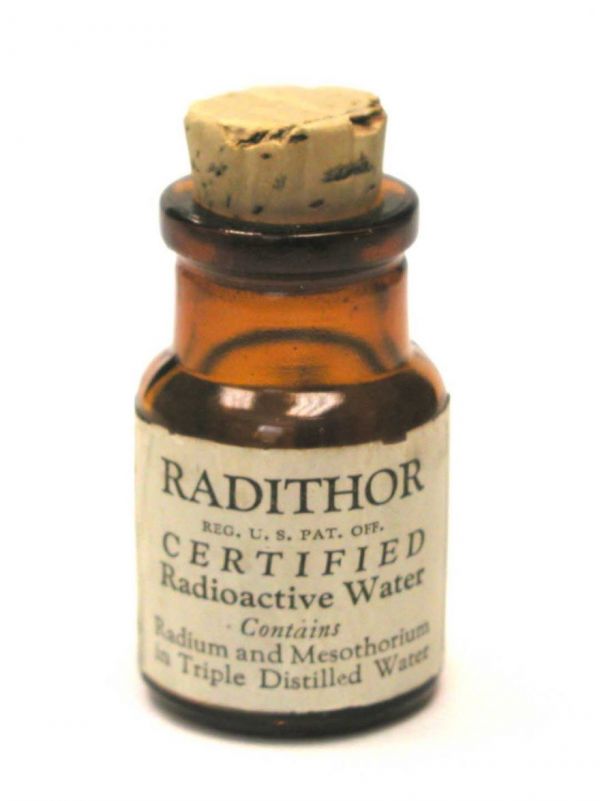
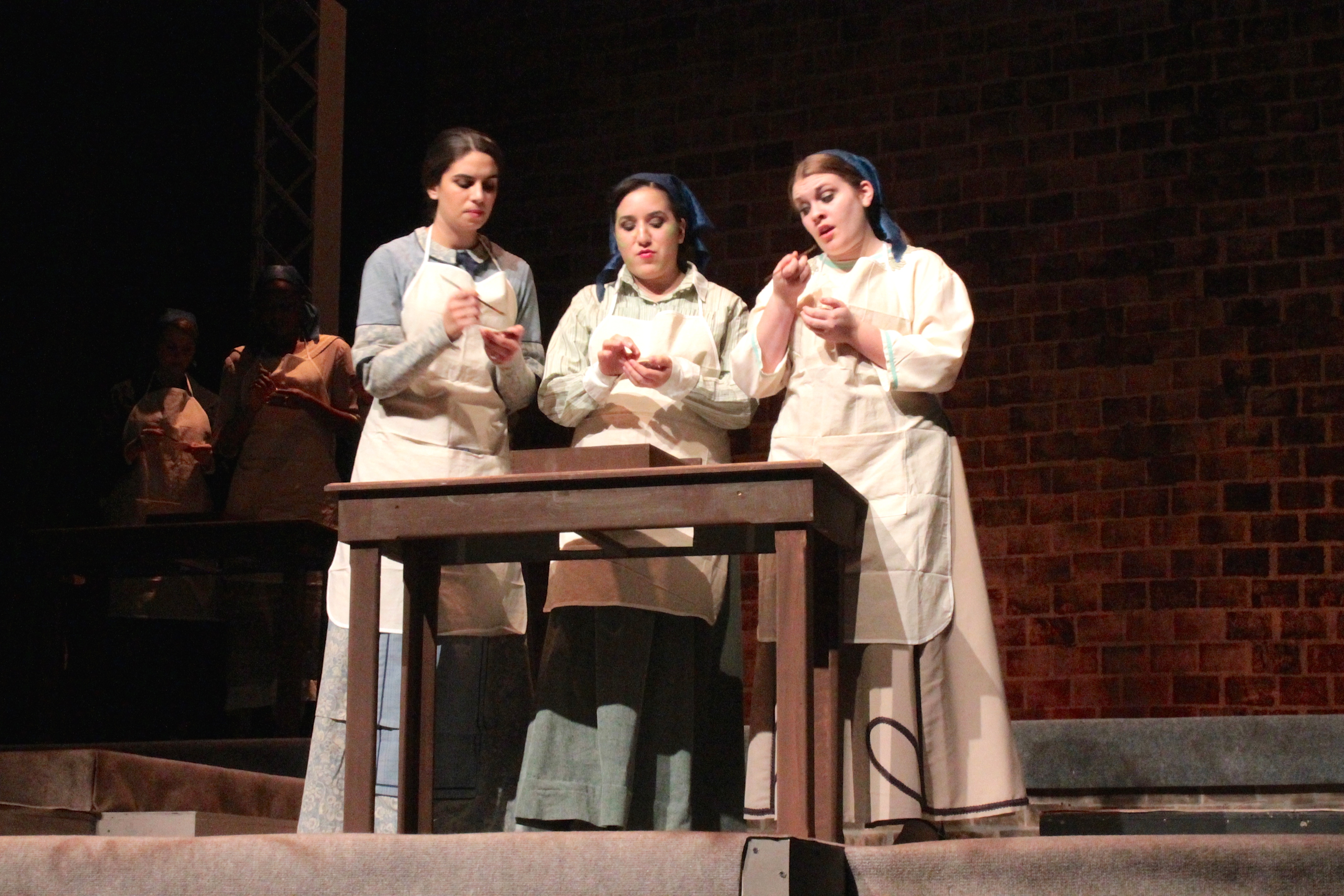
 

Burst number one — the long-awaited one-act version of Radium Girls is now available here  from Dramatic Publishing.  Cover photo courtesy of Andover High School Drama Guild, which performed it so  well the students walked off with acting, design, and technical awards.


As I wrote in this post, I finally caved to pressure (encouragement) from a director friend to write a short version for his students to perform in competition. This came after many years of requests from high school drama teachers to do cuttings for competition. The publisher and I agreed that it made sense for me to write my own version — so here it is at last.


It’s actually a 60-minute version cuttable to just under 40 minutes, and even before it was published, there were 10 productions lined up, continuing to win recognition for the students.


I’ve written before about the surprising trajectory of this work. Radium Girls has been produced in full around the country–65 productions last year alone–and occasionally outside of the U.S., with multiple productions in Canada this year.  I had never envisioned that kind of afterlife for the play—and I’ve been wondering for a long time how I can duplicate that success with another script.


I fully admit that I came to writing for young people reluctantly — Radium Girls not a script I ever imagined was suitable for high schools, and it was not my intention to market it to schools. But given the subject matter, the number of strong parts for women, and the fact that you can cast it with a lot more than the original nine actors, it is actually a great fit for schools.  And over the years I’ve come to see that I’ve got a manifesto–if I’m going to write plays for young actors, then I’m  not going to underestimate their intelligence or engagement in the world.


And that’s what is part of what drove me to write another play of mine–Salvation Road–which will be staged this summer at the Capital Fringe Festival in D.C. (link here).  It was the winner of Walden Theatre Co.’s Slant Culture Festival competition and performed amazingly there by the young actors in the theatre’s conservatory. It has been produced at New York University and Seton Hill University, and I’ve gotten some interest from several other schools this spring. So I’m hopeful of more productions later in the year.


That’s the second burst! More on that play soon.

Life and Afterlife of a Play, Part 2

Some amazing news came to me through Google Alerts a little while ago.


I’d set up a weekly tracker to follow productions of a few published scripts. Most of the time it highlights calendar listings and occasional features about productions I was already aware of, but it’s a nice way to catalogue press coverage. Once in a while you get a quotable gem, but not too many surprises.


radithorExcept for the alert I received the day after Christmas. I knew that Seton Hall University had a production going in the fall. But I didn’t know that Seton Hall had selected RADIUM GIRLS as its summer reading assignment for  its incoming freshman class last year.  That’s 1700 students, roughly, who were required to read the play and discuss it in freshman seminar as well as in other courses. A whole lot of buzz.


This news came to me when Google Alerts swept up an announcement by the university about two of its student winning an essay contest inspired by the play.


According to the announcement, student Gabrielle Hunt wrote about “modern day ‘slut-shaming,’ or the act of making a person, especially a woman, feel guilty or inferior for certain behaviors or circumstances that deviate from traditional gender expectations. She suggested that the radium girls exemplify what it means to be confident in who you are and stand up for yourself.” And student Patricia Boccard focused on the theme of corporate responsibility by relating the radium girls’ story to the current domestic debate surrounding hydraulic fracking.


Seton Hall is located in South Orange. N.J.—very near where the play is set–so the story of the Radium Girls is a home-town tragedy with many echoes into the present day. The factory where it took place was an EPA Superfund site that only recently has been dismantled.


Radium Girls, Seton Hall University Theater Department

All of which is to say – 15 years and more than 300 productions after its world premiere, RADIUM GIRLS is still going strong in ways I never began to anticipate when I was struggling through the early drafts. It is gratifying to see how the play has generated so much reflection and connection over the years. Even though the story focuses on women who lived and died nearly 100 years ago, it is still relevant and still compelling. And I still get email and Facebook friends requests from actors who’ve worked on productions and say it was one of the most rewarding experiences in their young careers.


As I wrote before, I finally succumbed to pressure from my publisher to write a one-act version for school competition – something I’ve been thinking about and dragging my feet about for a long time. It wasn’t until my friend, high school drama teacher Steven Barker leaned on me to do it – with the promise of a workshop with his students at Camp LeJeune High School—that I finally got off the dime and went to work.  Steven and his students performed the play in competition in the fall of 2013 and in the early winter of 2014, Susan Choquette, director of theatre arts at Andover High School in Andover, Mass. staged the competition version in the 2014 Massachusetts Educational Theatre Guild Drama Festival. It was one of fourteen plays out of 117 initial entries to advance to the final round and netted a number of awards in acting, design, and technical excellence for her students.
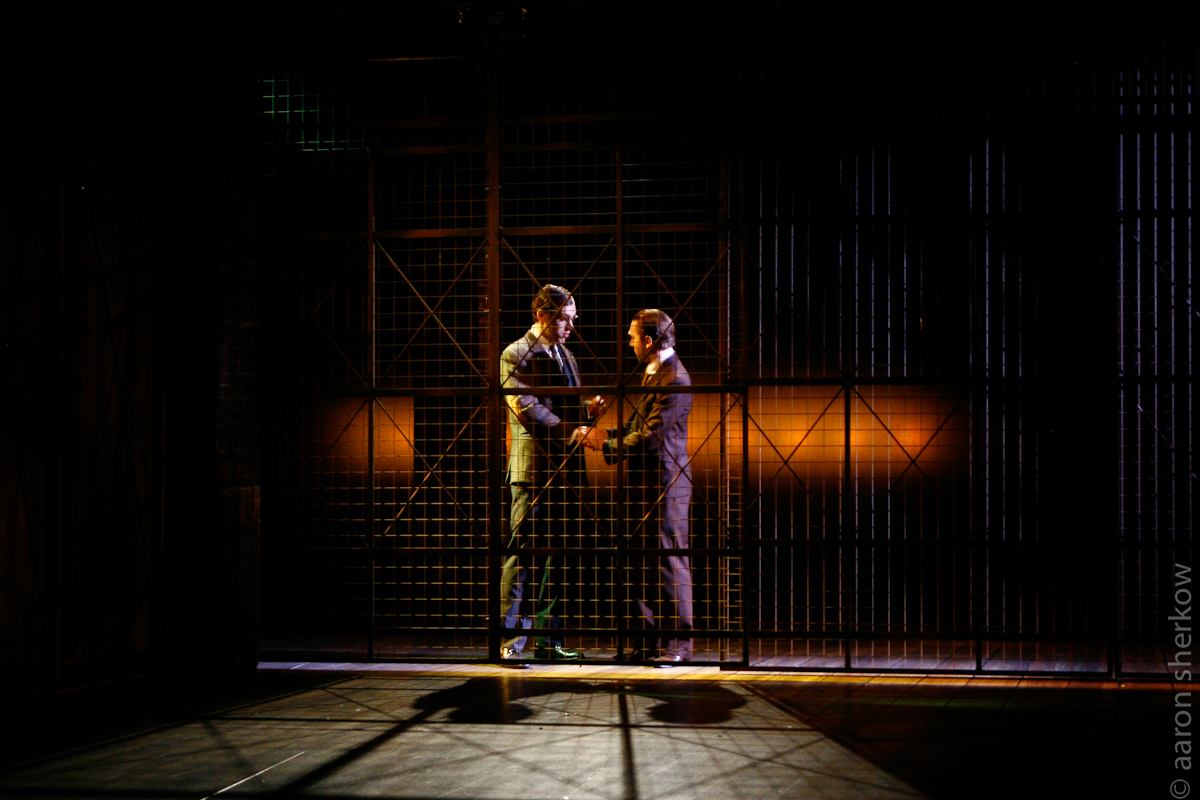
 

For a long time I had simply felt overwhelmed by the prospect of whittling my script from 2 hours and 10 minutes to 40 – but with Steven’s help, I found a way in—a tighter frame for that sprawling story. I ended up with a 60-minute version that you can pare to 40 by removing selected scenes. The one-act version is coming soon from Dramatic Publishing and promises to do well. So far, even before the script is out, we’ve got nine schools lined up to perform the competition piece this spring.


On days like today, when my head is still swimming from a back-to-back rejection letters, I think about the projects I’ve undertaken that have had the greatest impact. You never know who you will reach or how. It may take many years, but there are unexpected payoffs. That’s why, when it comes to the arts,  faith is the most important virtue. Faith and perseverence. I have a hard time remembering it, but every now and then the universe sends a warm reminder.


Untold Stories

“Murderer!”


A week ago I stood outside Studio Theatre on 14th Street in Washington, D.C., with my friend Jacqueline Lawton and endured that accusation—that we were killers of innocents.
 

Our crimes? Writing four-minute vignettes based on the true stories of women who had abortions. In my case, my scene was inspired by a young woman who braved a line of anti-abortion protesters—very like the line outside the theatre that night—and went ahead with her decision to end an unwanted pregnancy.

The protesters were vehement in their conviction—55 million innocents dead, blood on your hands, how dare you?


My answer: Why don’t you come inside and see the play? And then we can talk.


Jackie and the protesters - photo by Lloyd Wolf
Jackie and the protesters – photo by Lloyd Wolf

I was one of nine other D.C. playwrights whom Jackie had invited to participate in Out of Silence: Abortion Stories from the 1 in 3 Campaign. A project of Advocates for Youth, a nonprofit with a mission to help young people make informed and responsible decisions about their reproductive and sexual health, Out of Silence consists of 13 scenes intended to give voice to women whose stories are seldom heard—stories of women who had undergone abortions for all sorts of reasons, all deeply personal and individual, and who (mostly) had no regrets about it.


It’s not a story you hear very often, and it doesn’t fit with the usual narrative of a troubled woman struggling to decide to end a pregnancy, then spending years in recrimination and sorrow over the choice. Certainly some women do have deep regrets—but a lot of the stories collected by Advocates for Youth in their 1 in 3 Campaign reflect a different reality. The campaign is so named because 1 in 3 women will have an abortion in their lifetimes, and so far, they’ve gathered about 700 testimonials.  And for many of these women, having an abortion was a liberation.


I will confess that when Jackie first contacted me about the project my initial thought was to say no. I’m neither an advocate for abortion rights nor an advocate against them.  I’m ambivalent. Had I ever been so lucky as to conceive, I  don’t think I would have let circumstances persuade me to end the pregnancy. I’m childless by default; not for lack of trying, but because nature and opportunity did not coincide to allow me the family life I had wanted for so long. And I feel very sad about that.


But I also know that for many women, an unexpected pregnancy is not good news. For some, it’s an agonizing discovery. Young, scared, unemployed, battered or abandoned, victims of rape or other violence, chronically ill or for other reasons poorly equipped to bear and raise a child, they sort through their options and decide that abortion is the only thing that makes sense. And I don’t believe it’s for me or anyone else to decide for them that they must go through with the pregnancy if they have decided they can’t.


So after thinking it over, I agreed to sign on and write a scene from the point of view of a character that I can’t relate to very well—someone who decides she is going to do this—and try to tell her story without judgment. For the protesters outside the theatre, this makes me complicit in murder—a line of reasoning, if you call it reasoning, that I also cannot connect to very well.


And not one of them accepted our offer to come in and see the play.

A scene from "The Line" in Out of Silence.
Shayna Blass and Tuyet Thi Pham in “The Line.” Out of Silence: Abortion Stories from the 1 in 3 Campaign (Advocates for Youth) Photo by Lloyd Wolf.


Which I thought said a great deal about what their true agenda is. Because it seems to me that if you are truly pro-life, as you claim to be, then you have every reason to see this play. Why not see it? Why not see the lives of individuals who are making a choice you find abhorrent? Why not hear their stories and try to understand why they feel driven to this choice? And if you want them to make a different choice,  understanding their stories might enable you to offer them an alternative that works.


One major reason a lot of women choose abortions is economic; a number of the vignettes in the evening illustrate that harsh reality. Abortion is a choice, but for some impoverished women, it really isn’t a choice, it’s the only option they have because they are backed into a desperate corner.


Seems to me if you want to prevent abortions, you might want to understand that reality. You might then decide to work to ensure that birth control is available to anyone who wants it, regardless of income. You might see the value of public health initiatives and sex education efforts. You might advocate for social programs to support single mothers, or for public funding to underwrite child care or to sustain organizations that try to connect pregnant women with adoptive families—so that instead of screaming bloody murder at a stranger in crisis, you are working to offer her a solution.


A little compassion might go a long way.


But that’s not what this movement is really about. It was clear to me, standing outside the theatre last week, looking at those outraged faces screaming at me and Jackie, condemning us to hell and worse—without knowing a thing about us—I realized these particular protesters had no interest in understanding any point of view but their own. And they aren’t there to persuade. Their purpose is to harass and intimate. Their real agenda is punishment—to condemn women for their sexuality, to berate them for their audacity in refusing to accept the consequences of their “sins.”


One thing I know: Nothing they said that night persuaded me to back away from this project. If anything it made me more determined to expand my scene into a full-length play. It emboldened me to tell the rest of the untold story – and by doing that, find my way inside the experience of someone completely unlike myself, who makes choices I don’t think I would make, and to write her character with authenticity, compassion and–dare I say it?–respect.


Open Carry Meets Stand Your Ground

I’ve cribbed this photo below from the blog PQED—it depicts a demonstration of Open Carry activists in Texas, claiming their second amendment rights to scare the crap of any thinking person nearby. They’ve made a cause of toting their assault rifles into such dangerous zones as fast food restaurants and discount department stores, all in the name of freedom—or what passes for it in this country. I don’t know about you, but if I ever see a parade like that coming in my direction, I’m getting the hell out of there,  which is, effectively, what PQED advises. The best way to respond to Open Carry is to leave the place at once, and don’t bother to pay before you go. Let the gun activists pick up your tab.


opencarry

As I was writing this post today, another news item popped up on Facebook illustrating the obvious hazard from too many people wandering around with guns. Late-night partying in Indianapolis ends in tragedy when one guy bumps into another on a crowded street—and both are armed.


This raises the question of what happens when Open Carry meets Stand Your Ground. Guessing the answer will be–more of what happened in Indianpolis last night.  It’s only a matter of time before someone mistakes one of those Open Carry demonstrations for a crime in process and decides to make a pre-emptive strike.


If nothing else, this latest round of madness illustrates just how far around the bend we’ve gone in this country. After so much senseless slaughter committed by crazy people with assault rifles, this is where we’ve come—celebrating the right to own and carry the mass killer’s weapon of choice by marching them into commercial enterprises.


Open Carry sees itself as the protector of gun rights under assault—the threat coming, I presume, from wild-eyed liberals like me who’ve read the rest of the Constitution and know something about punctuation. (We can have that argument in another post, but suffice it to say there are two clauses to the Second Amendment, not just the one the National Rifle Association likes to quote.) The right of peaceable assembly is also in the Constitution, and I think a good argument is to be made that Open Carry demonstrations infringe on that right for shoppers and diners who find the display of armament so unsettling that it prompts them to disperse. These kinds of demonstrations, I suppose, are also meant to show that those fine Texas Patriots™  just ain’t scared of us wimpy members of the literate set, though they sure don’t mind terrifying anyone with the common sense to be concerned that maybe, just possibly, that thing they are carrying could go off by accident. Whether they intend it or not, let’s hope their own foot is the only casualty.

(more…)

Bad Manners and Bullets

A debate, not entirely civil, has erupted on my Facebook page over a heart-wrenching incident in Florida. If you’re a regular reader of CNN online you already know about an argument in a movie theatre that left one man dead, his wife wounded, and a retired police officer in jail without bond for pulling the trigger on a man who had refused to stop texting during a movie.


According to published reports, Chad Oulson, 43, met up with his wife for a Monday lunch date and a matinee in Wesley Chapel, Fla. Previews were rolling when he began to send a text—to his three-year-old daughter’s babysitter.  Behind him was Curtis Reeves, 71, and his wife. Reeves apparently asked Oulson to stop—how he asked is not clear, but the encounter escalated into an argument and Reeves left to find a manager. When he returned, CNN reports:


The man who had been texting, Chad Oulson, got up and turned to Reeves to ask him if he had gone to tell on him for his texting. Oulson reportedly said, in effect: I was just sending a message to my young daughter. Voices were raised. Popcorn was thrown. And then came something unimaginable — except maybe in a movie. A gun shot.


Oulson died at the scene. The following day, Reeves was arraigned and denied bail. According to the Tampa Tribune, Judge Lynn Tepper found no basis to believe his claim that he was in fear of attack when he shot Oulson—a potential “stand-your-ground” defense under Florida law:


The Pasco County Sheriff’s Office reported, though, that while Reeves claimed Oulson struck him with an “unknown object,” no such object was found and witnesses did not observe any punches being thrown. Oulson did throw a bag of popcorn at Reeves, the sheriff’s office reported.


The central question this tragedy has raised among my circle is the degree to which the victim contributed to the altercation—and to his own demise—by texting in the theatre and getting into an argument when asked to stop. To me, the bigger question is what this horrible incident says about the lies being peddled by the gun lobby, which pushes all guns, all the time—that an armed society is a polite society, that more guns means we are all safer, that the best defense against a bad guy with a gun is a good guy with a gun.  This kind of escalation is not rare, but it seldom involves a respected former member of law enforcement.


I’ll address the etiquette question first, however, because among some theatre people I know, the use of cellphones during performances inspires an almost atomic level of rage—to the point that it almost becomes  a public safety issue in itself. This incident has inflamed some of those passions. Online I’ve seen cruel jokes about Chad Oulson’s death, and in recent discussions, I’ve been startled to discover how much anger has been reserved for the victim.


The argument I’ve heard goes like this: Both men were wrong. And even if Reeves’ reaction was over-the-top, that doesn’t make Oulson’s behavior right. My initial response to that statement was astonishment. And it was hard to offer reasoned reaction. But having thought about it, I have this to say:  “Wrong” is not a uniform concept when it comes to degree or gravity.  Yes, we can agree that texting during a show is wrong. We can agree that shooting a guy in the chest is wrong. Both of these things are wrong, but they are wrong in utterly different ways and in different spheres. One is a breach of etiquette; the other is a criminal act. So they aren’t even in the same universe of wrong, and to demand that we recognize Oulson’s wrong behavior and consider it a provocation for Reeves’ wrong behavior reveals a strangely twisted sense of proportion and causality. Even if you argue that Oulson’s share of the blame is relatively small, it still ignores the fact that etiquette and public safety are two completely different arenas of life, governed by completely different considerations.  They intersect only at the point where bad manners become so extreme that they cross over into criminal behavior. Which is pretty much what happened here—except that it was Reeves, not Oulson, who crossed that line.

(more…)

Tone-Deaf and Life-Stupid at Metro

The annals of stupid are long and deep, but some of the worst offenses, I think we must agree, occur in the course of trying to sell something—particularly when that something is very transparently a load of bull.


Keep in mind I grew up on Virginia Slims commercials, back in the dark ages of analog TV, when Madison Avenue decided to grab hold of (that is, exploit) the nascent women’s movement of the late 70s and turn it into a pitch for cancer in a stick. I for one was thrilled to learn that my sex had earned the right to choke to death right along with the guys. Enjoli perfume wasn’t far behind when it came to offensive advertising. If you don’t know what that was—consider yourself fortunate to have been born after 1980. 


But apparently the Washington Metropolitan Area Transit Authority–which we folks in D.C. fondly refer to as “Metro” or, in some quarters, “the ride from hell”– didn’t get the memo. So they don’t seem to realize that we women have come a long way, baby, and therefore have other things on our minds besides a new pair of shoes or frying up the bacon in the pan (And yes, after 10 hours on the job, I will let you forget you’re a man—unless you plan to cook dinner, honey. But I digress).


Photo by Lucy Westcott
Photo by Lucy Westcott, on Twitter @lvzwestcott

Check this out—it’s the latest in Metro’s series of ads aimed at informing us of the fantastic progress being made in improving the transit system, which is notorious for performance issues and equipment failures—not to mention fatal collisions. The foot-crushing capacity of Metro’s ineptly designed escalators was once the worst danger facing an inattentive commuter, but since the 2009 wreck on the Red Line, things have taken an ugly turn. As it has been well-reported, Metro’s problems stem from its long-standing policy to save money by putting off fixing things until they fell apart. Needless to say this short-sighted approach to maintenance has caught up with Metro, and now that the agency has embarked on a multi-year effort to finally set it right, the agency has also embarked on an ad campaign (god knows how much that cost) to let us know just how great things are going.


The ad in question has caused quite a stir for its blatant sexism ( DCist  here, and Buzzfeed, here, had a few choice things to say). Ho hum who wants to hear about Metro’s improved performance when we can talk about shoes? After all, we are really only interested in shopping, aren’t we, girls? Shopping and fingernails, I guess. Woman as bimbo is a tired old trope, and the fact that the two women in question are women of color only adds to the insult. But this is garden variety sexism—the advancement of stereotype in the guise of humor.


For my money, the offensiveness of the ad goes even deeper—because it reflects a peculiar kind of narcissism unbecoming to a public transit agency whose mission is, well, to serve the public. Considering that this poster is supposed to impress the cynical commuter, I don’t think Metro has much to brag about. I mean, I don’t know, maybe going 8,200 miles between breakdowns is good for a bus, but really who gives a sh*t? I’ve driven my VW 50,000 miles without it ever breaking down—so I kind of agree with the woman on the right. That doesn’t sound like much to talk about, so why don’t we talk about shoes?


It gets worse, though, when you look at another ad in the same series—two dudes chatting each other up about—I am not lying—rail fasteners. Because Metro has replaced 30,000 of them and we all need to know that and be very very impressed! But, sorry, Metro, I am not particularly impressed with the number of rail fasteners  you’ve replaced. You are, in fact, operating a railroad, so it seems to me that putting down rails and rail fasteners ought to be something you do pretty routinely. Yes, 30,000 is a big number but that only speaks to the fact that you spent a lot of years not doing the work that you should have been doing all along, so no, I am not especially impressed.


Guys don't talk about shoes.
Guys don’t talk about shoes.

I will tell you what will impress me:


I will be impressed when I notice that my trip is actually smoother and faster, and I get to work on time.  When breakdowns and delays become a rare occurrence—instead of an almost daily routine—then I will be impressed, thank you.


All of this points to the essential self-absorption of the campaign itself, because these figures are internal metrics–the kinds of numbers that excite bean-counters and engineers, bragging rights for the system’s managers to take to the board of directors. For somebody waiting in the rain 40 minutes for the next bus, or jammed into a Red Line car that is stalled on the tracks because of a signal problem, these kinds of details don’t add up to jack. And there is no reason why they should.


The commuter is the customer—on the receiving end of the service, which is to get from place to place on schedule. A railroad bragging about how many rail fasteners it put down is like Dell  trying to sell computers on the basis of how many screws it uses to attach the motherboard. Glad it’s in there, guys, but all I care about is when I hit that power button the thing fires up and loads my applications.


When it comes to Metro there are only two statistics that matter to me: 1. Exactly how many minutes late are you going to make me today? and 2. What is the probability that you don’t kill me before I get there?


Anything else is just noise.


UPDATE: Looks like Metro is not just sexist but racist too.

Life and Afterlife of a Play

Sometimes you hear The Call and are compelled to your destiny.


And sometimes you hear The Call and hang up on it —because the message sounds garbled and the Voice of Destiny bears a strange resemblance to Phyllis Diller the morning after she went through all the cheap champagne alone.


That’s pretty much the way I felt about requests from high school drama teachers to chop my magnum opus RADIUM GIRLS to smithereens for the sake of some obscure forensics competition in Texas. Please. Can’t you recognize my genius? You want to cut my play to 40 minutes? Not only that you want me to read your cutting and approve it? Why don’t you just pick up a pencil and stab me in the eye? Haven’t I suffered enough? But in a moment of weakness – or maybe after a glass of champagne, I don’t remember – (might have been chardonnay, come to think of it)  I told high school drama teacher Steven Barker (yes that one, the evil one)  that I would adapt the play for high school drama competition. Forty—okay, forty-three-and-a-half—minutes of pure gold, just for you Steve. And because I never could say no to a cute guy, I also found myself high-tailing it to Camp LeJeune for a long weekend in late September and working with his students for two days to run through and tighten the script.

An expression of appreciation from Camp Lejeune


While I was there I also conducted a playwriting workshop for a number of the students. (This actually was more fun that writing the adaptation). For my trouble I was rewarded with this coin (see the photo) by the headmaster of the school—in appreciation of my service–and well-fed by parents and friends who turned out to see the full run-through on Saturday afternoon. And it was a blast! The kids were terrific—driven and dedicated– and by Steven’s report gob-smacked hysterically excited to have the writer actually show up and watch them work. And because I was able – at Steven’s suggestion — to find an angle on which to hang the shorter version, the adaptation came fast and sure.


Radium Girls is the story of the dialpainters who were poisoned while painting watch dials with radium-laced paint in the 1920s. The original is a big, sprawling, epic story replete with Brechtian devices and comic interludes to provide some relief amid the pathos. It is written for ten actors to double into nearly 40 parts—which explains why the play had a short life in professional theatre but has a long run on amateur stages, with nearly 300 productions in high schools, universities, and community theaters throughout the United States and abroad.  When Steven first approached me about the adaptation, I thought it would be impossible to condense the entire scope of the action—which covers 10 years in the original— into 40 minutes. I found out differently ….


(more…)

Bring Me the Head of Steven Barker

Let’s just get this straight from the top: I have nothing against Steven Barker. From everything I’ve seen he is a perfectly nice person, teaching drama to kids at Camp Lejeune and generally staying out of trouble. Except that he caused me untold misery over the past 10 days by suggesting that if I wrote a competition version of Radium Girls, he and his students would produce it this fall.  I don’t know any playwright who can resist those three precious words “I will produce,” so I set to it—and I am in pain.

The Evil One
The Evil One


Setting to it means I’ve had to exhume the bones of a play I wrote 15 years ago and try to find a way to cut a two-hour-and-twenty minute epic that spans 10 years, involves 38 characters and relies on a clever lighting designer into a 40-minute one-act suitable for high school drama performance in a festival setting.


Steven is not the first to suggest that I do this, but he is the first director to promise a tangible result if I did. And having dived into the wreck, I recall now that there is a reason why I’ve ignored this suggestion for years. Because it’s a damn miserable thing to go over a play you thought of as finished and realize—-uh, no.. Understand that when you set out to write a full-length play you flatter yourself that you’ll create an uncuttable script– so airtight, so carefully crafted, so beautifully rendered that you can’t cut a word without sacrificing something essential. Understand that you are deluded. Radium Girls is a pretty good piece, but it isn’t flawless and sifting through it I see plenty of places to cut. But rendering it into a 40-minute version goes beyond cutting – that’ involves a rethinking.


Steven called me in June, a couple of weeks (all right, months) after I had promised my publisher the same thing. I’d been peppered with so many requests from high school drama teachers to approve this cutting or that cutting, that my editor thought it would make plenty of sense for me to do my own cutting, particularly since I’d suggested a blanket order that anyone who wanted to perform the play for competition could either do complete, selected scenes, or not do it at all. I had no interest in slogging through the chop jobs offered me by various drama teachers – and each one would have required my specific approval, which meant sitting down and reading what they thought could go. No. So I said to hell with it, but something happened this year to make me change my mind.


A community theatre troupe in Massachusetts recently scored a big hit with a cutting I had agreed to more than a year before–either in a moment of weakness or inspiration, I am not sure which. In part, I thought the director had a pretty good handle on it and in part I thought it could mean more exposure in a frankly more lucrative market. (Turns out I was right about that.) Let’s face it, community theatre runs of three to four weeks are routine. Most high schools do two or three performances at the most—and the difference in royalties is ten-fold.


So, yes, I made a crassly commercial calculation, but there’s an artistic impulse behind my decision to do my own one-act version of the play—I get to shape the results, and nothing stops me from writing new material.  And nothing says that the one-act version has to cover the same ground as the full-length. But I asked Steven what it was about the play that he found so compelling—and he told me that he liked the character of the company president, a man who makes terrible moral compromises but also suffers from it. He liked the aspect of regret.


And he suggested that the one-act begin where the full-length ends, with the character of Arthur Roeder wandering through the graveyard in Orange, struggling to justify his misdeeds to his daughter. This gave me an immediate frame—but instead of opening in the cemetery, the one act opens in the condemned factory, with Roeder going back for one last look before the building is to be torn down. Now this of course messes with the chronology even more than I did in the original, because the building was still standing in 1999 when I wrote the play – but it serves my purpose dramatically.


This frame also positions the corporate man as the story-teller, and the story is his effort to rationalize his immoral choices to his adult daughter. He fails to do so to his own satisfaction, even though she ultimately dismisses his sins—it is also clear she never fully understands the magnitude of them and like so many of us, prefers to brush it all off rather than confront her own culpability—the way we are all culpable as consumers of ill-gotten goods.


Steven and his students will sit down with the script in September. I’m eager to hear what he thinks.

Unexpected Impacts, Part II

The Burlington Players of Burlington, Mass., took a trip to the State House in Boston July 26  as guests of the Massachusetts Legislature. The occasion: The community theatre troupe had walked off with the highest prize in its field a month before—Best Show Award at the 2013 American Association for Community Theatre (AACT) annual festival on June 23.  The play was RADIUM GIRLS, and the accomplishment was singular in a number of ways.


996538_450175341746415_1105337355_n
Team Radium at the Massachusetts State House

Director Celia Couture tells me this event marked the first time in 20 years that any Eastern Massachusetts company had won the top award at AACT. Not only that, to get to the competition in Carmel, Indiana, the all volunteer cast and crew of  27 had to raise $44,0000 to cover the costs of travel, housing, and  conference fees, as well as shipping sets, costumes, and props required to perform their 60 minute cutting of my play. That figure, she notes, is a number of times greater than the actual production budget for the full-length play in 2011, which Burlington had produced to wide acclaim.  The success of that production prompted the company to take the play to state and regional competitions.


The day the competition production won the  nationals, my in-box on Facebook was aflutter with excited messages from cast members who’d friended me months earlier, to let me know of their triumph and thank me again for the script.


By the various accounts I’ve heard, competition at AACT was fierce—Radium Girls received more nominations than any other production—out of 12 shows in the festival—-including best actor and best director— and placed in none, until the final moment, when the award for best show was announced at the Saturday night ceremony that concluded the week.


Burlington Players production of Radium Girls
Michael Govang and Craig Howard in Burlington Players production of Radium Girls

The company’s triumph offers a lot to reflect on, considering my initial reluctance to approve a cut-down version for competition. I’m accustomed to these requests, but invariably they come from high schools and the understanding usually is that what is presented is a selection of scenes. But for some reason I agreed to the cuts Celia proposed, and the result has been to create an opportunity for another troupe of artists to carry on with a play they had fallen in love with. And it is not an easy script. I still believe the play requires a smart, firm director to move it and keep it on point – if I could do it over, I think I’d reshape the first act—but even the weakest productions I’ve seen over the years have managed to convey the strength of the story itself.  It says something that Radium Girls is approaching 300 productions since its premiere at Playwrights Theatre of New Jersey more than a decade ago. And I’m continually amazed at the fierce devotion it seems to inspire in the actors and directors who’ve undertaken the challenge.


One of the most eloquent testimonials to the play was posted by Burlington cast member Nick Bennett-Zendzian. The night of the big win he wrote this on his Facebook page:


All of my theatre friends (which would be most of you) know that feeling of finality that comes with the closing performance of a show you’ve been working on. There’s the realization that each moment you are having on stage that night is the last time you will ever experience that particular moment. You think of the months you spent working on that scene, and then once it’s over, that scene is done, and you’re not going to be visiting it again. It’s a very bittersweet feeling. … It’s come to the point where I literally cannot imagine my life without any of these people. From the moment we were all cast, we clicked. We celebrated each other’s triumphs, and worked together to overcome the difficulties we faced on the journey. … It was a shining example of what theatre is supposed to be, and has become the standard I will use to measure the success of all the shows I do in the future. … This show has changed me for the better, and I will always, *always* be grateful for that experience.


In playwriting, we often measure our successes in the number and status of productions, thinking that if we aren’t produced at big LORT theatres, if we can’t get an agent, don’t see our work celebrated in American Theatre, can’t get the lit manager of the small storefront company to call us back—then our work has no value. We forget how very individual responses are to the plays we write. The fact is, the work is out there, and when any company takes it up and embraces it the way this company embraced Radium Girls, the result is transformative—not just for the audiences that see the play, but for the actors and other artists that work on it.


I never met any of the folks involved in the Burlington show – but they have reached out to me, and I’m grateful that they thought to bring me into the loop to share their progress, frustrations, and ultimate triumph with the play. I’m many years removed from the struggle of writing it, but these kinds of experiences restore my sense of balance. Success is not always measured in the ways we think it ought to be, but we are not always in control of our theatrical fortunes. I don’t know why professional theatre never embraced the play — well I do know why, it’s the cast size — but the fact that Radium Girls has had a long life in the amateur market is an amazing thing to me. I’ve written before of the psychic rewards of hearing from excited actors who worked on a successful production. But it’s good to be reminded again of what that all means.


Radium Girls took three years of my life; it was the result of a long-time obsession, and I think the fact that I poured my heart and soul into it is reflected in its pages. That the play has been a vehicle for the artistic triumphs and personal growth of other artists around the country is a gratifying realization. It shows that when we sit down to write, we can never know what impact our efforts will have  in the end, but above all else, it is important to have faith in ourselves and soldier on; if we believe strongly in the work, and if we are brave enough to invest our hearts in it, then  it will find its place in the world somehow and its meaning will be deeply felt.


Thanks for the Burlington crew for allowing me to learn this lesson once again.

The Other 9 Percent

Locally Grown Festival Image (2)Theatre J hosted a town hall meeting for playwrights on Tuesday night (June 25) and the room was bursting with amazing stories of a D.C. theatre scene that is about to break out as a worthy rival to Chicago, Minneapolis and even—yes, they said it—New York.


Among the most interesting reports from the field – to borrow a term from Theatre J Artistic Director Ari Roth – was a preview by Gwydion Suilebhan of his annual analysis of the D.C. season, in which he logs the number of new works going up, the percentage of plays by D.C. playwrights, the percentage by women and writers of color and so forth. He’ll have a lot more to say about it when he blogs about it next week—but here are two numbers to chew on until then: 31 and  9.


The first is the percentage of productions slotted for the 2013-14  season that can be considered  new plays—that is, experiencing a first, second, or third production.


The second is the percentage of plays by local writers, and according to Gwydion, it’s significantly less than the current season – in fact, nearly half. This year the figure was 16 percent. And these numbers, by the way, don’t include that crazy, hazy, mazy zone of self production known as the Capital Fringe.


What happened? I imagine Gwydion will have some things to say about that—he described it as a discouraging development, as it would have to be for anyone who has dedicated himself as tirelessly as he has to the cause of promoting local writers to local theatres. It remains to be seen whether that’s a statistical blip or the beginning of a trend—I suspect the former–but that 9 percent is a good number to keep in our heads because it gives us a strong sense of where the landscape is currently. Maybe it’s the dark Irish in my genes,  but sometimes I find a discouraging word weirdly motivating: we have work to do and one single statistic makes the case more clearly than anything else.


For any theatre community to make its mark outside its own small circle of  fans and friends requires that it dedicate itself to new plays. Otherwise it has nothing to offer to a new generation of theatergoers—and such theatre ultimately ensures its own demise. If you have nothing new to say, then eventually you have nothing at all to say, and no one has any reason to listen.

(more…)

The Troublesome 9.7 Percent and the Break-Through Play

Caridad Svich invited me to participate in the Artistic Innovation blog salon that she is curating for the 2013 TCG National Conference: Learn Do Teach in Dallas). The post below is cross-posted from the salon and can be found at the TCG Circle here.


Playwright Caridad Svich asks how a path can be made for innovative theatre artists.


That’s a question for the ages—because every age has redefined the form and function of theatre. But in our age and in this culture–so driven by commercial considerations that most playwrights cannot rely on their craft for a living—the question is particularly acute.  We all know that the American theatre faces a crisis of poverty—but it is not just a poverty of resources. It is also a poverty of ideas and confidence. And this poverty forces even the non-profit theatre to obsess with finding the next big hit, the next hot writer, and to find refuge in the next Big Name New Play—that one with all the buzz.


The reason for this can be summed up in a single statistic: 9.7 percent.


That is the percentage of the U.S. population that attended a live performance by a not-for-profit professional theatre company in 2010, according to the National Arts Index 2012, a survey of arts attendance in 81 markets. Based on TCG estimates, that figure represents some 31 million Americans who attended professional theatre outside of New York City. That’s down from a peak of 34 million in 2003—and for the record, does not include attendance at Broadway tours. Recent figures from the National Endowment for the Arts tell a similar story—that attendance at live professional theatre has eroded in troubling ways. But of course we do not need a survey to tell us what we have witnessed with our own eyes.

(more…)

Salvation Road at PTNJ


On March 15, Playwrights Theatre of New Jersey will feature a reading of Salvation Road as part of its ‘Forum Soundings’ series, focused on youth-centered theatre. This is the latest step in an ongoing development process for the play, which originated as a one-act at the Philadelphia Fringe Festival in 2009, was workshopped at New York University and the Utah University Youth Theatre, produced at NYU in October and at Walden Theatre in November and is due for another production at Seton Hill University in April.

I sat down with  Jennifer DeWitt of PTNJ for a brief interview. The interview and more details about the series  can be found at PTNJ’s blog.


1.       What inspired you to write “Salvation Road?”

Originally a friend of mine who was active in what was then known as the Cult Awareness Network commissioned a play about the cult experience. I agreed to write the play, which I had intended as an “issue” play for theatres that tour to schools. But I didn’t really like the results; it was didactic and a bit predictable. So I tossed it in a drawer and did other things. Then in 2008 the successor organization to CAN–now called the International Cultic Studies Association–was holding a conference in Philadelphia and my friend wanted to present the play there. I went into a panic because I just did not like the script, but by then I had decided to take a different attack on the subject matter–which was to write about the people who are left behind, trying to make sense of what is going on. I had some experience with that–my sister was involved briefly in the Unification Church a number of years ago–and so I drew on a few details that I remembered from that time. So for me the play is really about the brother who is confused by his sister’s rejection of the family and trying to make sense of her need for an organization like the Disciples.


2.       You write in a variety of styles and genres. Do you let the subject matter dictate this or do you wake-up and say “today I plan to write a historical drama therefore I must find a subject?”

Plays for me are about wrestling with a question or an observation. The inspiration comes from all sorts of places–something I read in a newspaper or online, a book I’m reading, a photograph or an anecdote–even a painting or sketch I see in a gallery. I come across something that triggers a question. With Radium Girls, the immediate trigger was a chapter in a book on mass media that I came across online. I read the story of the New Jersey case and thought “How could this happen? Why does it keep on happening?” And I developed an obsession with the story. I knew starting out that the play was going to deal with the uses of denial in some way. But then I set out to do my research and in the process realized that I also wanted to tell the story from two points of view—the women in the factory and the men who owned the company.  It was a long struggle to come to a structure that worked, because it was an early play and I was not really confident in myself to do the story justice. But really I borrowed from Brecht, working in presentational scenes with more naturalistic scenes—and advancing the action in an almost cinematic way. So Radium Girls is really Epic Theatre.


Most of the other plays I’ve written are historical in nature–period pieces–though I am starting to write contemporary stories. And while in many cases the exchanges between characters are naturalistic—the structure usually isn’t; there is usually some element to the construction of the play that departs from 20th Century Realism. One artistic director described me as an “impressionist.” And I think that is largely true–certainly was true of The Good Daughter. There, the idea was to approach the scenes like photographs in a family album–that as you flip through the pages and through the years–a story emerges–and there are great leaps in time between the photographs, but you ultimately get a sense of an arc and a resolution.


I am drawn to period pieces because, like Shakespeare, I think audiences needs to look backward in order to look at themselves. You put some distance between the experience of contemporary audiences and the story you are telling them—and they can receive it better, especially if you are delivering a fairly harsh critique wrapped in the form of entertainment.


But I’m also interested in finding a shape or an approach that suits the material—and how this comes about is a bit of mystery. I sit with the idea or the characters for a while sometimes before the answer comes. Salvation Road is essentially a buddy movie on stage–two guys hit the road looking for a girl. And the structure is cinematic because the audience I am aiming at is used to receiving information in short bits; they are used to film and video and online entertainment and gaming–and that informs the way the play is put together. The newest piece I am working on now is a mash-up between a social satire and a murder mystery–with no solution to the mystery, which I am sure will really infuriate the audience. So it starts out as a comedy and gets darker as it goes. More and more I guess I am interested in bending forms—taking very familiar forms and working in that framework to force the audience to adopt a point of view it might not otherwise adopt. So I think the work is subtle in that respect—and I like to think it’s subversive. That’s what I tell myself.


(more…)

From STEM to STEAM: Putting the ‘Art’ Back in Science Education

On Saturday Feb. 23 I crossed something off my bucket list–and was a keynote speaker at the 2013 Theatre in Our Schools Mini-Conference in Richmond, a project of the Virginia membership of the American Alliance for Theatre & Education. Organizer Steven Barker invited me to speak on the topic of incorporating the arts into other core education courses. Here’s what I had to say:


Steven asked me to join you today to think through a most intriguing question: How can we transform STEM to STEAM? Or more to the point how can  that missing “A” can be incorporated into—and actually enhance—the teaching of  other core subjects?


STEM as we know is an initiative to emphasize SCIENCE, TECHNOLOGY, ENGINEERING, and MATH in the classroom.


For lovers and teachers of the arts—all manner of art—-the fact that music, painting, dance, theatre—even literature—is missing from this initiative is not just an unfortunate oversight, it is troubling evidence of an attitude that pervades our culture, which is that the arts are secondary—extraneous, fluff, unimportant—while science and technology are essentials.

Da_Vinci_Vitruve_Luc_Viatour


To believe that is to be blind to the role of the arts not just in education but in our very lives. As theatre artists, we know that the arts and humanities are vital to helping young people develop essential skills— not the least of which is the exercise of the imagination. Without the ability to envision, the scientific mind would never think past the world as it exists now in the present.


In a recent essay, Princeton University Professor Danielle Allen reminds us:


“That you can’t do well in math and engineering if you can’t read proficiently, and … reading is the province of courses in literature, language and writing. Nor can you do well in science and technology if you can’t interpret images and develop effective visualizations — skills that are strengthened by courses in art and art history.” And, I would argue—by classes in drama.

(more…)

The Long Shadow, Part III: A Soldier’s Story

The package that arrived  in my mail in mid-January came as a surprise, not because it was unexpected, but because the contents were so much more revealing than I had imagined possible—nearly 70 pages of Photostats, detailing the movements of my late uncle Jack in the three years he spent in the Army Air Force during World War II. Jack’s records were largely intact, having survived a 1973 fire in the National Archives in St. Louis that had destroyed nearly 80 percent of the military records then on file.


What those records revealed was a short life far more troubled than I had realized.


Jack’s induction papers, 1942

My mother never spoke of this mysterious younger brother unless prompted by one of us, and even then her stories were spare and brief. What I knew of Jack was that he had been rebellious and bold and that he had died, in an apparent car accident, years before I was born. The few photographs we had of him showed a cheerful, friendly young face with a spark of mischief in his eye;  it was left to us to fill in the details, and I did: in my mind he was reckless but sincere, good-hearted and kind, adventurous and noble—the kind of uncle every girl wanted, who would have taken me on long walks and imparted to me the wisdom he had gleaned from his years of unrest. He might have been a bit wild, but he was not a bad boy; he simply loved a good time and took nothing seriously. We knew this to be true; we could see it in his eyes.


But the picture that emerges from the documents is much different, much darker—a story of a troubled young man with a fondness for drink—who lost more than 100 days of service to his habit of leaving the base without permission—who married because he had to—and who died in the fall of 1946 by an unspecified cause. I knew the cause—I’d already gotten his death certificate—he died alone in October 1946, killing himself by putting  his head in the oven and turning on the gas.

(more…)

The Artist as Activist–Take It to the Street or the Stage?

On Jan. 26, after a month of planning that was kicked off by Arena Stage’s artistic director, Molly Smith, the March on Washington for Gun Control took place—the first major public demonstration since the Sandy Hook shootings to demand a change in our national gun policy. I was in the thick of it, having helped (in a very small way) to assist the organizers and turning out to march and rally—one of more than 6,000 people who showed up that morning.


It was a first for me, to be in the midst of a movement, rather than at the edge of it, observing it.  Up to this point in my life, the most I’ve ever done for any cause I’ve supported is to write a check. And while money helps, muscle is sometimes more important.  So when Molly issued a call, I decided that it was time to do more than just lament a sorry situation. So I turned out to offer my limited skills at research and writing, helping collect as much information as I could on the issue and, with the help of my friend Cat,  searching out  the names of gun violence victims whose names were carried in silent protest down Constitution Avenue.


A view from within the crowd.


Later that afternoon, there was a demonstration of another kind at Georgetown University’s Gonda Theatre—where Obie-winning playwright Caridad Svich, artistic director of NoPassport theatre alliance and press, had organized a Theatre Action for Gun Control in collaboration with Theatre J and interdisciplinary arts ensemble force/collision and Twinbiz.  The presentation of short works included new pieces by Neil LaBute, Jennifer Maisel, Winter Miller, Matthew Paul Olmos, Svich, and others.


This juxtaposition of street theatre—which this march and rally surely was—and a theatre of protest in a traditional setting invites the question of what role art can play in responding to atrocity. The slaughter of those poor children and their teachers in Connecticut was so awful that any response at all seemed stunningly ineffectual. What can you say in response to such madness? And who is more crazy– the gunman who took the lives of people totally unconnected to his personal hell–or the rest of us, who allow these conditions to persist and go so far as to argue–some of us–that our constitutional right to firearms trumps any reasonable effort to curtail their unlimited availability to individuals unfit to use them.


Are there moments when art has nothing to say? Or is it just that I have nothing to say; and for that reason decided to take up an action at Molly’s invitation and do what little I could to make the point. Are there times when the only reasonable response is to put down the pen, take off the costume, and take to the street? These are the questions I put to Caridad and her response is below the fold.


(more…)

The Metaphor of the Gun

Something happened last night. It got me so fired up I was ready to let fly with both barrels.

Illustration by Mike Diehm


So you know it was big.


And that is why I had to step back and think about my choice of words.  How ironic that the first thing to come to me was the metaphor of the gun.


I’ve been volunteering now for a couple weeks to help bring about a March on Washington for Gun Control. This is an effort by some D.C. theatre artists to call attention to the need for a more sensible gun policy in this country — one that could have prevented the carnage at Sandy Hook. So when an apparent coordinated effort by opponents of the march shut down our Facebook page for several hours last night, I was outraged.


I guess when you don’t have an argument, you resort to dirty tricks. And no question it is easier to shut down  the argument you cannot refute than to actually refute it—and that is another irony, that such vocal proponents of the Second Amendment seem to forget that there is also a First Amendment.


But there I was, firing off emails (oh yes I know) invoking the metaphor of the gun.


Both barrels, loaded for bear.  And it occurred to me how trapped we all are within a language and culture so besotted with weaponry.

(more…)

A Man Without a Conscience, or How to Stick it to ‘Big Gun’

When I started this playwright’s blog, I wasn’t interested in whining about the reasons why theatres don’t produce more plays by women in general (or me in particular, let’s be frank) or the politics of production or the reasons the whole industry is at once relentlessly P.C. and yet so damn conservative.  I wanted to write my plays and  blog about the impulses that led me to them.  I wanted to understand process and come to a better understanding of my craft. But as the man said, life is what happens when you are making other plans–and in my case, and yours, since you are reading this–life is apparently what happens because you haven’t yet run into the business end of a .223 caliber Bushmaster rifle. And so we get to keep on breathing by virtue of the sheer dumb luck that, for now at least, we are not in some lunatic’s line of fire. And this realization, along with my outrage over what happened at Sandy Hook Elementary last week, has stirred me from my petty self-absorption to, shall we say, a vigilant stance.


Given the insane gun policy in this nation, the chances of any one of us being blown away in a random act of extreme violence is just too damn high. All it takes is for you or me to be at the wrong place–in front of the FBI Building, for example–at the wrong time–the exact moment when the lunatic du jour pops another 30-round magazine into his Glock—for us to be prematurely dispatched to that great big Arsenal in the sky.


Realizing their vulnerability after Columbine, schools undertook efforts to protect their students from armed gunmen. They stepped up security, they instituted “drills” so kids could practice how to run and hide. As a teaching artist, I happened to be on hand one day during just such a drill, and I found it surreal—the teacher locking the schoolroom door, the kids quietly huddling in a corner, and h how matter-of-fact the discussion afterwards.


But there is just something seriously sick about this, when school children have to engage in “drills” to train them how to avoid a mass murderer in the hallway–instead of the rest of us actually DOING SOMETHING to prevent there being a mass murderer in the hallway.  Back in my day, all we had to contend with in school were the usual bullies, occasional fire drills and predictable Friday afternoon bomb scares—it was the 70s after all—and  for most of us, the bomb scares just meant an excuse to get out of gym class. Today, we have gunmen who shoot their way into the building and massacre six year olds en masse. And if we can’t come up with some way to stop atrocities like that, then we might as well pack it in and return to the cave, because we do not live in anything approaching a civil society.


So what to do? Or more to the point, how to do it?


Not surprisingly, the internets have been afire since Friday with all sort of posts decrying the horror of it all, lamenting our lame gun policy, lambasting the National Rifle Association (mea culpa) and using Facebook as a public forum to express a general sense of outrage, disgust, and helplessness. (Interestingly, the NRA has disabled its Facebook page.) Vigils have been organized and protests are threatened. But for a truly compelling rant about how to really kick the shins of big gun, read this guy. Drew Magary argues that the real target of our frustration should not be the NRA and its four million dues paying members, but rather, the money interests behind the NRA itself.


(more…)

27 Dead in Connecticut: A Call to Action

27 Dead in Connecticut


The headline is too familiar, and yet, despite a culture saturated by gun violence in fiction and fact, we feel absolute revulsion at the senselessness of it all.


Twenty-seven dead in Connecticut, 20 of them children. They were kindergartners, five or first-grade students, six and seven years old. In the world of innocence, these were absolute innocents–and they are dead because this nation and its political leaders lack the nerve to stand up to a well-funded and wrong-headed gun lobby.


Why? Is the cry that goes out, again and again, when we see these headlines. Why, why, why?


Why? Because a troubled boy of 20 had access to a Glock and Sig Sauer pistols—two magazine-fed semi-automatic weapons capable of firing off more than 100 rounds within minutes, as well as a .223 caliber semi-automatic rifle – a military style assault rifle similar to the one used by the serial killers that stalked the D.C. metro 10 years ago.  This is the weapon, authorities say, that Lanza used to gun down his victims at Sandy Hook Elementary School on Dec. 14.


Why? Because, even though gun ownership in this nation is concentrated in the hands of only a third of its population—our political leaders lack the moral courage to fight for a sensible gun policy.


The National Rifle Association’s slippery slope argument is that if the U.S. government curtails the use of any firearm—no matter how lethal—that is the beginning of the end for our constitutionally guaranteed right to gun ownership in the United States. And by their logic, an assault rifle is the equivalent of the shotgun my brother-in-law keeps on hand at his farmhouse in the mountains of Pennsylvania, where bears have regularly crossed into his property. A Glock is the equivalent of the rifle my brother once used to hunt deer.


According to the NRA, weapons designed for military use belong in the hands of ordinary citizens like Nancy Lanza. She apparently thought so, too. The shooter’s mother is dead by her son’s own hand, murdered with a weapon she had bought herself. According to news reports, Nancy Lanza was the legal owner of the guns her son used to commit mass murder.


This a crime so horrific that some of us wonder if it is not, at last, at very long last, the final straw.


And as often happens at times like these, we wonder what we, as theatre artists, can possibly say or do about it.


(more…)

The Christmas Card from Hell

I got a Christmas card today from the child molester’s wife.


This is not an unusual event. For the past several years, this woman has persisted in sending me birthday cards, Christmas cards, Easter greetings—this despite what should have been a clear directive to her years ago never to contact me again. Yet she persists.


For years I evaded her ridiculous missives, but somewhere along the line one of my misguided relatives gave her my current address and so, for the past few years, I have suffered through a series of “greeting cards” from this woman. Usually I throw them away. But tonight, for some reason, I am moved to action.


The door that wasn’t opened …

You see, I have the misfortune of being related to her husband and, thus, I was one of his targets. I prefer “target” to “victim” because I decided a long time ago that what he did to me was not going to define me forever. And if I was a victim once, I am no longer. But God knows how many more children have come into his line of fire—how many of his own children? We cannot begin to know; his life is a lie wrapped in denial, embroiled in deception. We can guess, but we don’t have the luxury of the confirmation. Once, long ago, I confronted him in the belief that I owed it to his children to try to stop him. But I could not stop him. The lie was too strong.


But his wife is a great curiosity to me. When we undertook to confront him, my sister and I,  in the process, we confronted her as well. Her anger was a sight to behold. She literally shook with rage. Not at him, of course. At us. For daring to tell. For daring to say what had happened and demanding—how dare we demand it!—an apology.


We never got it.

(more…)

Breaking the Block Part 6: Cooking With Commies

I confess to a panic attack the other day when I realized that not only  am I behind on the promised scene, I cannot tamp down my anxiety to write it. The excuses are piling up—production, yadda, hurricane, yadda, production, yadda, nostalgia tour, yadda, yadda, yadda—and now the latest: a nasty flu, which I soothed with multiple toddies  (yes, there was whisky involved, sue me) and homemade soup (leek and potato, recipe to follow. I do try to please.)


Chopping leeks had me thinking about what my characters might be having for supper on a Sunday night, and it occurred to me that I ought to scout out a Russian cookbook somewhere, circa 1930 (but in English please!) to get a sense of what Alexei’s mother might put on the table. Then again—a 1930s cookbook would have to be approved by The Party, I imagine, and would a bowl of Communist borscht taste different from the pre-war Tsarist variety? Alexei’s mother in 1930 would be at least 50 and presumably have learned to cook sometime before the turn of the century and very likely, with no assistance from formal recipes at all, so I imagine what she put on the table would be in no way influenced by Party approval but certainly by any going food shortages at the time.


All this ruminating takes me back to my basic problem: To write a scene of any authenticity I have to know a little bit of something about the characters and their physical world, and for this play especially, I feel a deep need to immerse myself in the culture and currents of the era. For book research, I have turned to the brilliant Orlando Figes and his phenomenal account of ordinary life in the Soviet era: The Whisperers: Private Life in Stalin’s Russia. (Even as I write these words I realize I need even more than that. A book alone will not do it—I need a tangible experience, but a visit to Red Square in not yet in the cards.)


Forty pages in, the takeaway from Figes’ work is the extreme intrusion of the Soviet state into the private lives of its people, the widely accepted understanding that privacy and personal happiness are luxuries that the people can no longer afford; their focus must be to build the ideal (Communist) state, and to do so, they must cast aside any notion of a personal life. It is heartbreaking in its idealism, realizing the number of lives shattered by the grinding machinery of Stalin’s police state. Even those of the truest believers.

(more…)

The Importance of Multiple Productions

Having seen the second production of  Salvation Road—third if you count the original one-act at the Philly Fringe in 2009—I have now received the kind of vindication every playwright craves: I know my script stands up.


With two different casts in two radically different incarnations—David Montgomery’s production at New York University featured original music, a rich sound design and a modular set, while Alec Volz’s production at Walden Theatre in Louisville was performed in the round with minimal sound and only four barstools as set pieces—the story of a young man in search of a lost sister is the same from one production to another.  Now having worked the play through several readings and workshops, I already knew that the script was fairly well constructed and I had a lot of confidence in it. But seeing it in a second incarnation showed me that the play was really there.  It lived on stage in a different way, but the fundamentals were the same.


Nan Elpers, Courtney Doyle, and Elese Whiting in Walden Theatre’s production of Salvation Road. Photo by Harlan Taylor.


Most playwrights, though, don’t get to this discovery, for the simple reason that most plays never get past the initial production, if they are produced at all. As we know, theatre in the United States has been peculiarly obsessed with world premieres—and this obsession works to the detriment of the form. Not only is it frustrating to labor so over a play that will never see more than a single production, it precludes a playwright from experiencing the essential next step in a play’s development. Because it is only the second production that will make clear to us exactly how well—or how poorly–constructed our play really is.  Simply put, if if what we deem essential to our play falls out of it when a different director and cast takes over—then we know that there are problems with the script.

(more…)

Salvation Road Redux

Salvation Road‘s run at the Steinhardt School of New York University ended abruptly with the arrival of Hurricane Sandy on Oct. 29. Compared to the loss of life, injury, damage to property, chaos and disruption visited upon the good people of Manhattan–one friend I know of is still without heat two weeks later–curtailing the run of a play on a college campus is really no loss at all.  Disappointed as I am not to have a full run, I feel worse for the students who worked so hard to bring the play to life; they threw themselves into the project with such enthusiasm, I know they must have been deeply disappointed that they could not restage the play at a later time. But alas, the Pless Black Box was booked with the next show coming in, and there was simply no space to perform.


Salvation Road at Walden Theatre, directed by Alec Volz

For me, the play moves on now to another production, this time at Walden Theatre in Louisville, Ky., where a cast of younger actors tackles the story of two guys in search of a girl who does not want to be separated from her guru. The production is Walden’s entry into Louisville’s Slant Culture Theatre Festival, described as “a laboratory for uncommon works” and hosted by Walden. Salvation Road will run in rep with The Debate Over Courtney O’Connell by Mat Smart, produced by Theatre [502] of Louisville; The Man With the Flower in His Mouth, by Luigi Pirandello, produced by Savage Rose Classical Theatre Company, and 5 Things, a devised piece by Le Petomane Theatre Ensemble, among other works.


Like NYU, the Walden Theatre is producing a large-cast version of the play. But this time, instead of college students playing high school age characters, the actors are area high school students who study in Walden’s conservatory program. This is a terrific opportunity for me to see how the play works as a youth theatre piece—and how well it is received by audiences of that age.


When I first wrote the play, I thought the biggest barrier to production by schools would be the subject matter–religion. But I was advised by a  high school drama teacher that cast size, more than subject matter, would be the bigger concern. Thus, I expanded what I had intended as a five-actor piece to a 90-minute play for 12 to 16 performers. However, the five-actor — actually now a six-actor — version still lives. During a workshop at NYU in the spring, I worked on that smaller cast version–simultaneously developing it with the 16-actor play, though we ultimately presented the six-actor version in public staged readings in June.


The differences? The larger piece creates a stronger sense of place; the atmosphere is richer. But the smaller cast play, requiring the cast to double into nine speaking parts, is a spare, stark telling of the story that for me, draws the focus more sharply. These are two different experiences of the story, and for schools that are interested in the issues raised by the play, involving more students in the telling makes a great deal of sense. But I still believe Salvation Road can find an audience in mainstream theatres and for that reason, I look forward to the production of the small cast version at Seton Hill University in April.


Salvation Road Opens Tonight

Salvation Road opens tonight with a cast of thousands ….


It has been a long process developing this play, a comic drama about a boy searching for a sister who has disappeared into a fundamentalist cult.


Originally a one-act for three actors (hated that version) the play underwent a massive rewrite in the summer/fall of 2008. I got up my nerve to stage the retooled one-act version, but on advice of a high school drama director — the fabulous Jennie Eisenhower — I developed it into this version, a full-length for 15 actors.  Jennie did not think the subject matter would intimidate a lot of schools, but the cast size–five to eight actors–would discourage a lot of high schools. A cast of 15 to 16 would be a much easier sell. With that in mind, I revised the play into a large-cast version. It subsequently received a developmental workshop at The Utah University Youth Theatre in 2011 as part of the American Alliance for Theatre in Education’s Playwrights in Our Schools Program.  This year the play was accepted for development during NYU’s New Plays for Young Audiences workshop at Provincetown Playhouse this summer. Ironically, the Provincetown project focused a full-length with a small cast (six actors doubling into nine parts).  This is the first time I’ve written a play with two versions–one aimed at professional production, and the other aimed at the youth theatre market.


The  Theatre Department of the Steinhardt School at New York University trains drama teachers — and there could be no better match for this play than a premiere of the full-length youthversion in a departmental production. It is a challenging topic for young actors and for their audiences, but I strongly believe young people have more going on inside than many of their teachers, and sometimes parents, appreciate.  My hope is that schools across the country will not be put off by the subject matter, but will embrace this play as an excellent opportunity for their students to explore issues of faith, spirituality, conformity, and control through the story of two boys caught up in the cult phenomenon.


The next stop for Salvation Road is a production at Walden Theatre in Louisville, Ky., Nov. 8-18. I’ll be going out there for a post-show discussion.


Breaking the Block, Part 5: The Exploratory Scene
Exploration is not always going to take you where you expect to go.

We’re back with my series on feeling my way through a draft of a new play. How to break through the block? In this installment, I’m looking at laying the foundations for an exploratory scene that might not necessarily make it into the play. This is my play about a man with an amazing memory, whose strange gift turns out to be a liability in the time and place (1930s Soviet Union) in which he lives.


In the opening scene that I posted previously, we are introduced to Alexei in the middle of an exchange between his psychologist and the NKVD agent who is questioning her. He enters the space as if he is coming into Natalia’s office at the hospital, rather than into the dingy office where the interrogation is taking place.


This introduction to Alexei and Natlia puts us immediately into the thick of their relationship. It also creates the   advantage of a high-stakes scenario for the doctor.


(more…)

After a Long Absence …

It’s been a month since I posted last. My apologies for my absence.  It was due in part to a family crisis.  My mother-in-law, who had been ill for several years, took a sudden, unexpected turn for the worst on Sept. 23 and died the following Saturday.


Doreen was a true lady who grew up amid a great deal of hardship but never saw herself as deprived. She lost her father at an early age, was sent away to Devon as a child to escape the Nazi bombing of London, and came of age at a time of genuine economic privation in post-war Britain. But she took it all in stride.


Even during the worst of her illness she never complained. And she slipped away quietly.


A rush of activity followed her passing—calling friends, relatives, making arrangements, simply sitting still and holding hands—the initial shock gives way to a grief that is expressed in so many different ways. Not always tears.


We struggled with finding the right words to remember her—and this is what we came up with to read at her memorial service on October 8:


Doreen Lucy Gregory,  Aug. 4, 1933 – Sept. 29, 2012

Anyone who met Doreen in recent years met a woman who had a great enthusiasm for life even though she was dealing with a debilitating illness.  “Life is sweet,” she said one day, and throughout her life, she found sweetness in many things, large and small—the pleasure of a brisk walk through Wentworth Woods, the excitement of holidays with family and friends, or the  taste of fresh picked raspberries from her own allotment.  Even an experience that was a hardship for many—being evacuated as a child during World War II—was a sweet one for her. She often said the five years she spent in Devon were among the happiest of her life.

(more…)

Now, Who Can’t Relate to This?

Sometimes you just have to open the Jack.

Tamara Federici’s production notes show why some playwrights ought to write fiction and be done with it. I particularly liked this one:


Regarding pauses: short pauses are short, three seconds or so, like the time it takes to sneak out a little fart, i.e. Lucia’s line “No, I told you to bring me the head of Cornel, not [little fart] Gary.”


Read more http://www.newyorker.com/online/blogs/shouts/2012/09/a-few-notes-about-my-play.html#ixzz278otRb00


Breaking the Block Part 4: The Worst Case Scenario

Some years ago I came across a funny yet utterly serious book called “Worst Case Scenario Survival Handbook” by Joshua Piven—a guidebook on how to survive a series of unlikely disasters—from an avalanche to a shark attack to the crash of a jumbo jet. So I immediately bought a copy for  an artistic director who has suffered through enough near misses over 25 years of running a not-for-profit theatre to write a guidebook of his own. John is also a risk-taker dedicated to new work and has a keen eye  and a lot of good advice for writers.  Early on, his advice to me was that I needed to “raise the stakes” for my characters, another way of saying I needed to put more pressure on them—because it is only under pressure that character is revealed.


It is true in life and true in drama that the way we deal with mess says a great deal about who we really are. The same fire that melts the fat hardens the iron—to borrow a borrowed phrase from some advice columnist I used to read religiously like a fool  (she gave a lot of bad advice). But it is also a no brainer to say that any character in desperate pursuit of something is always more interesting than someone who can wait another week or so and won’t suffer for the delay. What audiences want—savages that we are—is to watch someone suffer–intensely. The more agony for the character, the better for the story and the more interested are we in the outcome.


James Stewart’s manically lovesick detective in Vertigo comes to mind—it is part of what makes that improbable (and creaky) ghost story so watchable 60 years later. Nobody suffers better than James Stewart, but most of us are not going to get a Jimmy Stewart to play our leading man, so what we lack in spectacular acting talent we have to make up in a riveting script.  (Not that Vertigo isn’t riveting, but you have to admit it does defy logic. Why, for example, would anyone cook up such a convoluted murder plot that hangs on such an unpredictable element—the detective’s inability to overcome his fear of heights? Scotty conveniently falters on the bell tower stairs, but he could just as easily have closed his eyes and charged ahead, at which point the whole plot would unravel. And then there is the murderer’s great good luck in escaping the bell tower undetected—apparently because no one without vertigo bothered to go up the tower steps to investigate what actually caused the victim to fall.)


But plot weaknesses aside, Vertigo is a terrific example of a character under extreme pressure. The woman Scotty thinks he adores is actually someone else, hired to use him as a pawn in a plot to fake a suicide as a cover for murder.  And once the real Madelyn dies, clueless Scotty is skinned alive during the inquest that follows, as an investigator coldly concludes that his cowardice was a greater cause of Madelyn’s demise than the mysterious emotional upset that sent her up the tower. Who wouldn’t end up catatonic in a nursing home after that?


We have to admit—when it comes to scenarios for losing your sweetheart, this has to be one of the worst case scenarios of all time—as well as one of the more original.


This, then is a useful question to keep in mind when sketching out the scenario for your play. Aside from the obvious–have we ever seen this before?–we need to ask ourselves how we can crank up the pressure on our characters.

(more…)

Salvation Road at NYU

Salvation Road opens at New York University’s Black Box Theatre on Oct. 26. Tickets are now on sale and can be obtained online at www.nyu.edu/ticketcentral/calendar, or by calling 212-352-3101. Admission is $15 for general admission and $5 for students and seniors.

The show runs from Oct. 26 through the following weekend with performances at 8 p.m. Thursday, Friday and Saturday, 3 p.m. Sunday.


More details can be found here.

Where Does a Song Come From?

While I’m off on a holiday, I get by with a little help from my friends. One is Mike Diehm, a songwriter and poet who accomplishes what I can only dream of—he writes music.  As someone who has no musical talent, I stand amazed by anyone who can pull a few chords together, let alone write a six-minute ballad that lingers in my mind for days. So I asked Mike how he does that, and this is his answer.  Be sure to click on the links below for clips from two of the songs he discusses. D.W.G.

Songwriting Process

The following is from my favorite poet, H.W. Longfellow:


Before a blazing fire of wood

Erect a rapt musician stood;

And ever and anon he bent

His head upon his instrument,

And seemed to listen till he caught

Confessions of its secret thought


From “The Musicians Tale; Prelude; The Wayside Inn”

By Henry Wadsworth Longfellow


The songwriting process for me is very cathartic. I know I’m not the only songwriter to say that I write songs because there is some inner turmoil going on. I guess that’s why I’ve written so MANY songs, lyrics and poems. I am currently compiling a complete collection of my poetry, short prose and lyric poems. This process has been very therapeutic, something that I need right now. As I go through and do some edits I am realizing that I have been searching for a long, long time for a certain something. That certain something, I now believe, after almost 35 years of writing, has been a search for my SELF. I know myself much better these days, and I like it.


For me (as I’m sure a lot of songwriters will tell you) a song does not always begin in the same way. Sometimes I first come up with lyrics, sometimes a particular chord progression or even just one chord or, in some cases, just one NOTE. Other times a song will start with a melody stuck in my head. But no matter how a song comes to me if it feels “labored,” if I have to think too much about it, it will invariably be tossed, ripped up or otherwise discarded. The sixty or seventy songs that remain to this day are all songs that came quite naturally.


Mike Diehm, on the guitar
Feeling the muse

A lot of my songs and poetry do not even tell a “story,” instead there are more like moments in time, sometimes down to feelings that come and go in seconds or minutes. As a music lover and intense “listener,” I know I’m not alone in this. It’s like a piece of visual art. Everyone who views (or listens to) a piece of art will get a different feeling. That’s because the song CAME FROM a feeling that might have been very fleeting.


My best songs and poetry just “happen.” My best lyrics usually come out, literally, in minutes. The musical part of it can come quickly too, but in a song some arranging is necessary. It’s sort of a mathematical process. Finding a progression that is pleasing to the ear or at least makes sense mathematically.


Here are some examples. I’ll start with collaborations:

(more…)

Playwriting: Breaking the Block Part 3

Last week I wrote about an exercise from Michael Dixon to help raise the stakes in a scene. And here it is again:


1. Put two characters who share something in common in a place neither can leave. Write a scene in which the obstacles and stakes are high and clearly presented.


Working on my play about the man with the phenomenal memory, (working title: A Hero of the Revolution) I have decided that because the  patient can leave the doctor’s office if he wishes, there is more mileage to be gained from another, less expected scenario. What I come up with is a scene between an interrogator and his prisoner–in this case, the psychiatrist who is treating our guy. For the sake of the exercise (if not the play), the doctor is a woman, Natalia; the patient is Alexei, and the interrogator a tough character named Kreplev.  What Natalia and Kreplev share is a seething hatred for this man:


"Tsar Nicholas II"
The wrong guy at the wrong time


Tsar Nicholas II, an inept and bloodthirsty ruler of a nation struggling to emerge from feudalism at the end of the 19th century.


If ever there were a nation in need of a revolution it was Russia in 1917 — but ultimately what emerged was a government even more oppressive and bloody than the monarchy it replaced. In the Birth of the Modern, World Society 1815-1830, Historian Paul Johnson explains why, in a nation in which the concept of individual rights did not exist,  Russia’s fate could have been no different.


All of that is by way of prologue. For our purposes, we fast forward to the 1930s, when Stalin’s paranoia has kicked into high gear, and here we open our scene:


A HERO OF THE REVOLUTION, SCENE ONE

Lights rise on a drab office with sick green walls and a window overlooking a brick wall that sports an enormous banner picture of Stalin. Only a quarter of Stalin’s face is visible, an eternally staring eye. Kreplev, a government official, sits at a desk and Natalia leans against the wall opposite.


Kreplev has several files, which he taps on the tabletop. Each time he taps the files, the sound is like a rifleshot. Tap — tap — tap. Tap — and last tap, a light flashes outside the window — as if a gun has been fired, and the report of the rifle report echoing, echoing, echoing, gone. Natalia reacts to this by moving away from the window, but Kreplev does not respond to the sound. It is as if he so accustomed to the sound of gunfire that he can no longer react.


KREPLEV: Now then. I have very little time today, comrade doctor. And I imagine you too have pressing business.


Beat


KREPLEV: I do my best to keep things cordial. Please never let it be said that I have no respect for your profession.


NATALIA: Of all the things on my mind this morning, comrade, that … that is not something I have been troubled by …


KREPLEV: I will consider that a humorous rejoinder comrade doctor and not make a record of it.


NATALIA: Does it matter? Surely someone is taking notes.


KREPLEV: It is always possible. But if we have nothing to hide—then we have nothing to fear.

(more…)

Playwriting: Breaking the Block, Part 2

I have a play in my head that has frightened me for a long time because it will require considerable research to write authentically—and the stack of books I’ve accumulated to begin the work is a bit intimidating. Not that I can’t read; I figured that out when I was six, but there is a gap between book knowledge and lived experience—and what will be required ultimately, is an avenue into the lived experience of  individuals who struggle under constant scrutiny from the state. Now I have a great resource that I will talk about in future posts, but for now, let’s return to this fun little exercise:


Last week I wrote about Marsha Norman’s five sentences, in which you can get  at the arc of a story by filling in these blanks:


  1. This is a play about _____.
  2. It takes place _____.
  3. The main character wants _____ but _____
  4. It starts when __________
  5. It ends when __________.


For purposes of the exercise, as well as this new play, I have filled in the blanks as follows:

(more…)

Why a Play? Are Some Topics Too Hot for Stage?

An invitation arrives in my email to consider writing a new play about  a topic so current that taking it on at all seems  to be almost irreverent, given the anguish that many of the players still feel.  But I am not about to pass up an opportunity to work with the theatre in question, so I sit down to think about the challenge.


How do you write about recent tragedies that have shaken a community to its core? The pain is too new for black comedy and seems almost too raw for drama.


Dottie Sandusky Couldn't Go There
Dottie just couldn’t go there.

Consider the events that unfolded in State College, Pa., over   the last year. The trial and subsequent conviction of former Penn State Assistant Coach Jerry Sandusky on child sex abuse charges–and the vindication of his victims in a scathing report by former FBI Director Louis Freeh–are the stuff of TV police procedurals and movie melodramas.


What can theatre bring to the cultural conversation about this almost Olympian tragedy that a TV show or a film could not?


Why a play at all?


A torn-from-the headlines treatment might reduce the story to a straight-line mystery in which the open question is not whether the coach  will be caught and convicted, but exactly how he gets his comeuppance. It would wrap up in 90 minutes, and we could be satisfied that the wheels of justice turn quickly and neatly—with conveniently timed commercial breaks so we can tear away from the drama for another trip to the fridge.

(more…)

Playwrights Interview Playwrights: Me and Jackie

The wonderful Jacqueline E. Lawton has included me in her series on women playwrights in D.C.

My newest best friend

You can check out the interview here.

Thank you Jackie for thinking of me and including me in such illustrious company as  Laura Zam, Karen Zacarias, Renee Calarco, and Jennifer Nelson.

And you can check out Jackie  here.

And do check her out because she is one cool cat. She would be cool even if she didn’t write about me.

Playwriting: Breaking the Block, Part I
Typewriter? For Playwriting?
This is how they used to do it.


Eric Barker asks us to consider whether we are more creative when forced to work – or whether we ought to wait until inspiration strikes.


Citing Daniel Akst’s book Temptation: Finding Self-Control in an Age of Excess, he concludes that pressure to produce actually results in productivity.


No surprise to me—I’ve long known that setting a specific schedule to write almost always ensures that I, in fact, write. The trick is making writing a priority over all other competing interests—some of them compelling interests, such as the need to  go to my day job and actually earn the living that supports my playwriting habit.


But what to do when the juices don’t flow? Stare at a blank piece of paper?


As a founding member of The Playwrights Gymnasium, a process oriented workshop in Washington, D.C., I assure you there are many ways around writer’s block. And in this weekly feature, I intend to share some of those tricks with you.

(more…)

The Drama in Drink, or Vice Versa

Barking Up a Wrong Tree is one of my favorite blogs and here is why:


Eric Barker routinely compiles fascinating observations about all aspects of human nature and experience, with the stated purpose of learning to live life to its full awesomeness.  But me being me, which means predisposed to moments of dark ruminations, or in more pedestrian terms, a moody crank, I take perverse comfort from posts like these, in which Eric assures us that the crazy times just might be the best, at least when it comes to literary output.


Dionysius was the god of theatre for a reason.

Citing the Storytelling Animal by Jonathan Gottschall, Eric tells us that:


In studies of deceased writers— based on their letters, medical records, and published biographies— and in studies of talented living writers, mental illness is prevalent. For example, fiction writers are fully ten times more likely to be bipolar than the general population, and poets are an amazing forty times more likely to struggle with the disorder. Based on statistics like these, psychologist Daniel Nettle writes, “It is hard to avoid the conclusion that most of the canon of Western culture was produced by people with a touch of madness.” Essayist Brooke Allen does Nettle one better: ‘The Western literary tradition, it seems, has been dominated by a sorry collection of alcoholics, compulsive gamblers, manic-depressives, sexual predators, and various unfortunate combinations of two, three, or even all of the above.


Well that’s no surprise to readers of literary biographies, but what should we conclude?

(more…)

The Trickster in Your Play

One of the pleasures of stealing away to a theatre conference such as  the American Alliance for Theatre in Education’s (AATE) gathering in Lexington, Ky., last week is meeting theatre artists with a distinctly different view of process.


Such an artist is Steven Barker, who currently teaches at Camp LeJeune High School in North Carolina. Steven outright rejects the Stanislavskiian “get in touch with your emotions” approach to acting in favor of an analysis based in archetype and inspired by the writings of Frankie Armstrong and Janet Rodgers, co-authors of Acting and Singing with the Archetypes.


Reynard the Fox, a classic Trickster

The archetypal figure of the Trickster, or Fool, comes to us not just as  the Joker in a card deck, but in the guise of myriad  characters whose dominant trait is to embrace joy and shake off restraints imposed by society.  Huckleberry Finn comes to mind immediately, as does Pippi Longstocking, and The Cat in the Hat. (Coming off a conference dedicated to theatre for children, I can’t help thinking in terms of childhood literary icons.) And of course we see the Trickster in the cartoon characters of Bugs Bunny, Wile E. Coyote, and Bart Simpson, as well as in Shakespeare’s Puck and Petruchio.


In his workshop at AATE, Steven invited us to get in touch with our inner Trickster—for some that impulse is not buried all the deeply, but for others, the task of awakening him is not so easy. Over the years I’ve grown less inhibited, but not so uninhibited that I don’t balk at kicking off my shoes and strutting around a hotel ballroom clucking like a chicken.


The objective to the exercise is to expose drama teachers to the idea that there is a way to assist young actors in analyzing character that does not require them to dig into deeply personal emotional experiences in search of a sense memory that might apply to a key moment in a play. In Steven’s mind that kind of approach can border on exploitation when you are working with impressionable and often vulnerable young people.


To me the workshop in archetypes presents fascinating possibilities for exploration of character in the creation of plays.  How refreshing to break free of the psychological mire that informs so much of American storytelling and focus instead on the outline of character that must be filled in by its opposite. For every archetype has its shadow after all. The hero is plagued with bouts of cowardice. The Ruler veers toward the Tyrant. The Innocent Child has a bit of a Brat within. And the Caregiver Mother can devolve into an Obsessive Parent.


In charting out the psycho-biographies of new characters I find myself falling into the usual preoccupation with childhood traumas, trivial biographical details and hints of emotional upheavals that must surely inform the present action. How much more interesting might it be to chart character based on the qualities of the archetype. The Magician, for example, is on a quest to transform, but his fear is that he will be transformed in the process. Let us transplant the Magician to a cocktail party in the D.C. suburbs and see how this woman works on the Trickster next to her, whose quest is to enjoy life for its own sake but who fears that he might not really be living at all. What kind of fireworks will fly?


Steven informs me that Frankie and Darien will conduct a teacher training workshop next summer on Cape Cod that will incorporate voice, body, and imagination, to explore archetypal journeys and, in their words, “apply the work to text.” Interested parties should contact Janet Rodgers at jrodgers@vcu.edu.


Steven, a trained chef, will be doing the cooking. Perhaps I’ll see you there?

Playwrights Interview Playwrights: Adam & Me

The prolific Adam Szymkowicz is famously prolific in another way—interviewing other playwrights for his blog–and today he honors me as writer No. 484 on a venerable list that includes, among others–yes I’m bragging, yes I am, so what?–Liz Duffy Adams, Lonnie Carter, Kia Corthron, Julia Jordan, Rajiv Joseph, and of course my lovely and wonderful Jacqueline E. Lawton who always greets me with a hug.


My new best friend

Yes I am ecstatic to make Adam’s list of people worth talking to. Wouldn’t you be if you’d been slogging away at this as long as I have?


So while I’m braggin’ on it, here’s a taste of my own wisdom. Don’t I sound fine?


Q:  What advice do you have for playwrights just starting out?


A:  This advice is borrowed from Ira Glass. Be prepared to suck. Learning to write well requires a long, long apprenticeship. Mastering the form takes literally years and it takes a long time to find your voice and your style.

No. 484, circa 1896

As for me, I would say the earlier you start, the better, but no matter when you start, give yourself five years before you write anything worth showing to a theatre. Don’t try to get your stuff produced right away. Join a group or hire a tutor and write crappy plays. Write a lot of them, keep a journal, develop a keen eye for human foibles and a keen ear for natural language. Don’t underestimate the power of your own story, but don’t make playwriting your avenue for revenge or personal therapy. Nobody gives a s**it what happened to you as a kid. Your job is to write plays so stunning that when I come to see them, I can’t get them out of my head; so make me stop and take a deep breath and think twice about something I never doubted before. Whether I laugh or cry, make me pay attention and never, never let me off the hook. You are not writing to make me feel good, you are writing to reveal the world to me in a way I never saw it before. You can’t do that unless you are willing to go there yourself and bleed along with your characters.


Not that I follow my advice, mind you.


For the full interview, now that I know you’re fascinated, click here.

The Birth of Cute

And now for something completely different.

Word origins, always of interest to me, might be of interest to you as well. The Hairpin explains  the birth of cute.

Maybe I’ve just been spending too much time thinking about cute guys I used to know ….


So Produce a Different Play Already!

In the annals of theatrical chutzpah, this latest missive has to rank fairly high.


A theatre that shall remain nameless booked several performances of Radium Girls for the coming fall. Okay, cool. I’m excited, because this one looks to be a professional company, even though it’s only a single weekend run. Then comes this request, sent to me via my publisher: Would I approve some cuts to the script? Attached is a file containing a heart-stopping number of red scratch-outs.


Now, I’m accustomed to approving cuttings for competition. Radium Girls has been presented in a truncated form multiple times and won awards for the schools involved. I don’t mind; it’s clear in the context that the students are presenting excerpts from a larger work, and that’s fine. In fact, a lot of those competitions have generated subsequent full productions by other schools.


In this case, though, the theatre would be presenting a radically pared down version of my play for paying audiences. When I asked for the reasoning behind these cuts, what I got back was a doozy:

(more…)

The Subject of Study

“The strength of Gregory’s characterization of Judy is that she does not allow disability to become an all-encompassing character trait that merely paints Judy as either bitter or heroic. …  In short, by using disability as a dramaturgical device rather than a metaphor, a stereotype, or an all-encompassing world-view, Gregory has made the play and Judy’s disability more accessible and approachable to a mainstream audience without diminishing the reality of disabled life for Judy.

— Bradley Stephenson, Ph.D. candidate in theatre, the University of Columbia, Mo.


It is an odd sensation to find oneself the subject of study—and even stranger to discover that the examination will be shared at an academic conference. But let me wish Bradley Stephenson the best with his paper “Reclaiming Wholeness: The Dramaturgy of Disability in D.W. Gregory’s Dirty Pictures,” which he will present at the Association for Theatre in Higher Education (ATHE) Conference in Washington, D.C., Aug. 2-4. This is a project he’s been working on for several months—a final paper for a course he was taking at Mizzou on Women’s Dramatic Traditions—and I imagine it’s a pretty high stakes event for him, to present his work to his peers and superiors in this way. Most of the people in the audience are sitting where he aspires to, being university professors of theatre.


Staged reading of the play in NYC, funded in part by Montgomery County, Md. Arts and Humanities Council.

Speaking as someone who spent years making a living by writing about other people, I find it frankly kind of weird to read about my work through someone else’s eyes. But I’ve read the paper and I think Bradley has nailed it. I’m especially flattered by his conclusion that Dirty Pictures is “subversive.” That’s a word that applies very well to a play that presents a story in the familiar frame of sex comedy but goes on to upend the audience’s expectations of the characters. One actress who worked on an early reading said the play “explodes stereotypes.” I certainly hope so. So Bradley, I embrace your assessment of Dirty Pictures and I plan to use “subversive” in my elevator speech from now on.


Now, if nothing else, this episode  reveals to me how critical it is to embrace serendipity in our work and lives, because Brad’s enthusiasm for my plays dates back several years, to when he was a high school teacher/director in search of projects for his students. He originally had pitched Radium Girls as play for his school, and while it was not selected, he was enough of a fan to use the play as a basis for a class project once he got to Mizzou—and to talk it up with his professors, along with some of my other work.


Our conversations about his current project began with this email in February:


(more…)

Unexpected Impacts

Trolling through Google with coffee in hand is a favored Saturday morning time-waster, but this morning I came across a stunning discovery — Google images, more than 100, of various productions of Radium Girls.

To wit:

Radium Girls, Boston University

This visually arresting production, directed by Elaine Vaan Hogue at Boston University, was one I had the privilege to see.

But there are many others, some obviously more successful in the design and execution. The play has not made a big impression in professional theatre — but in universities, high schools, and now community productions, the story is told and retold. Fascinating to see how different and yet how consistent the interpretations seem to be.


(more…)

The Long Shadow, Part Two
My mother and her brother in 1937

The death of his mother as a complication of his own birth meant that Jack Collins would be raised by relatives, not all of them vitally interested in his welfare. In his infancy, his care was left largely to his father’s much younger sister, Margaret, then a winsome and cheerful 16-year-old; as he grew older,  he spent more and more time with his mother’s mother, Ida Finch,  and it was to Ida that he fled when his stepmother’s rages became too much to bear.


Jack was 15 months younger than my mother, and she described him sometimes as a “pesky little brother” who stole her roller skates and used the wheels to make a skateboard. Her tone of voice betrayed affection, though; I could see that she had loved him.  Generally, she said little of Jack, and we had only a few snapshots to anchor him in our imaginations: Jack at age six, blond and sweet, squinting into the sun as he grasps a croquet mallet; Jack at 14, gazing whimsically at the camera, as if daring the photographer not to laugh; Jack at 17, standing stiffly on a cold Easter morning, his best blue suit not quite fitting as it used to, his hair slicked back in the fashion of the day, his expression no longer so eager nor sweet. The boy who once put on such a good front was by now already grappling with the demons that would eventually destroy him. His attitude seems grim, resigned.


(more…)

The Alchemy of Collaboration

Working on a new play is always a challenge in isolation. After successive drafts, you reach a point where you lose the path forward—or worse, where the path splits into a dozen different trails and there is no clear indication which one is the right one to follow. That is the point, for me, when I need to hear the script aloud. A fascinating alchemy occurs when an actor takes my words and breathes life into them.


Sometimes the result is a great leap forward in the development of the script.

(more…)